
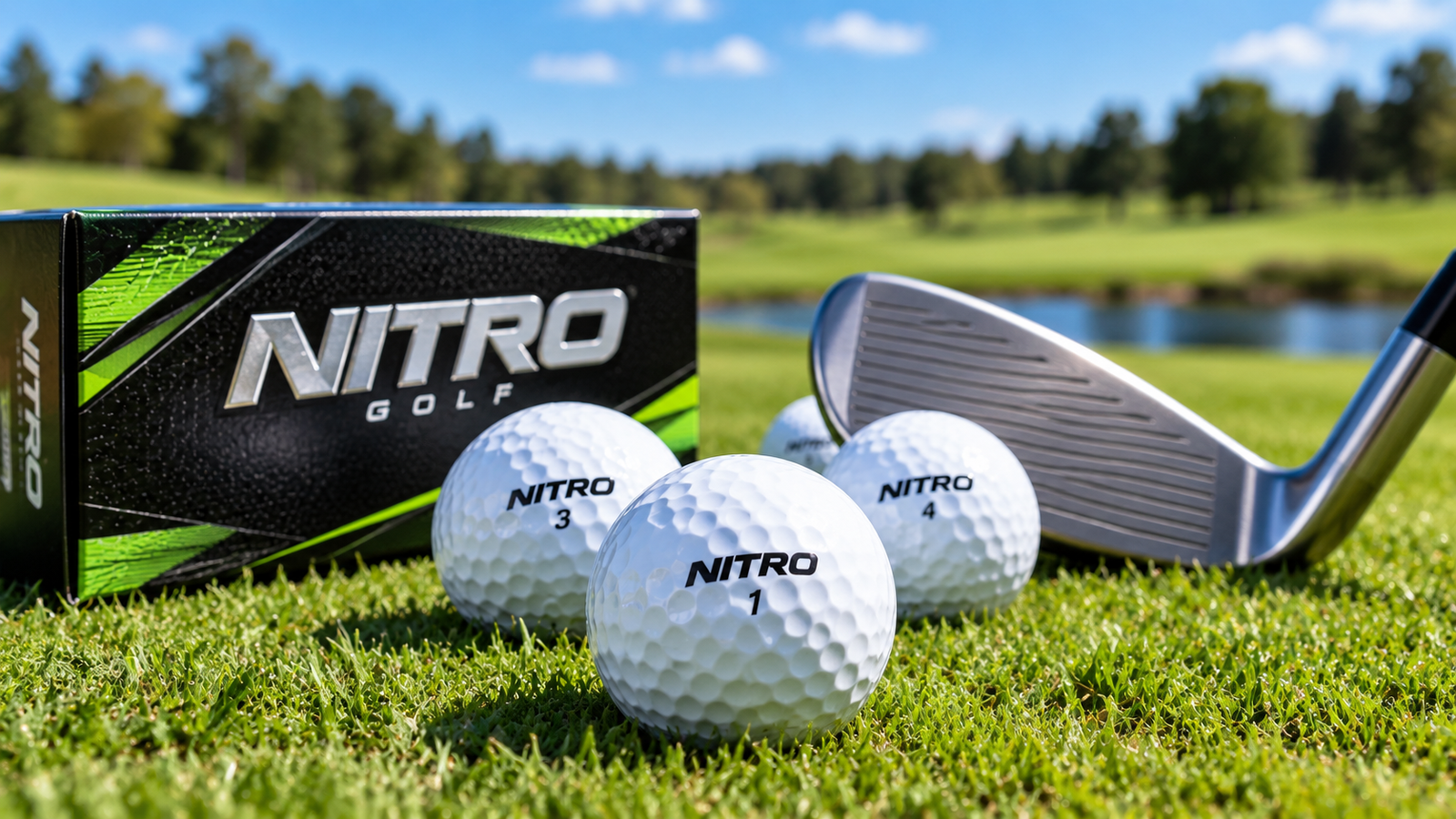
Yes, Nitro golf balls are good for the right player. They are cheap, tough, and built for distance, which makes them a smart pick for beginners, seniors, and anyone with a slower swing who plays for fun. What you trade away is soft feel and control around the greens. If you want the whole picture before you buy a pack, here is how they play, who they fit, and where they fall short.
What are Nitro golf balls?
Nitro golf balls are a value brand aimed at everyday golfers who want good distance without paying premium prices. Most are simple two-piece balls: a solid core wrapped in a tough outer cover. That build is cheap to make and hard to damage, which is exactly why the price stays low.
The cores are often described as titanium-infused, and the covers use ionomer or Surlyn, a hard plastic known for resisting cuts and scuffs. A two-piece ball like this launches high, spins less, and rolls out far. It is the same recipe most distance balls use, just at a fraction of the cost.
Nitro sells several models. The Ultimate Distance and Long Distance are the plain two-piece workhorses. The Pulsar is a three-piece ball, which adds a layer to give a bit more feel and control from tee to green. Many packs come in bright colors like orange and pink, which help you track the ball and find it in the rough.
How do Nitro golf balls perform?
Off the tee, Nitro balls do the one thing they promise: they go far. The hard core sends the ball off the clubface fast, and the low spin keeps it flying straight and rolling once it lands. Players with average and slower swings often notice a few extra yards on their drives, and even iron shots can carry a little longer.
Durability is another real strength. The hard cover shrugs off cart-path bounces, tree strikes, and bunker scrapes. One ball can last many rounds, which matters when you are the kind of golfer who tends to lose a sleeve every time out.
The honest trade-off: distance and toughness come from a hard cover, and a hard cover means less spin and less soft feel. You gain yards and lose finesse.
That trade-off shows up around the greens. Because the ball spins less and feels firm, it is harder to stop quickly on a chip or a pitch. On the putter, some players find it jumps off the face a touch fast, so the feel takes a round or two to dial in. Golfers with fast swings sometimes describe the harder models as feeling like hitting a rock, with a firm click you feel in your wrists.
Compression tells the same story. Many Nitro models sit in the low-to-mid range, from around 70 up to about 85 or 90. A lower-compression ball squishes more easily and helps slower swings get full distance, while it feels too soft and springy for someone who swings hard. That is the single biggest clue to whether a Nitro ball will suit you.
Who should play Nitro golf balls?
Nitro balls fit a clear group of golfers. Match yourself to the list below before you buy.
- Beginners. They forgive off-center hits, fly straight, and cost little, so losing a few does not hurt.
- Seniors and slower swings. The low compression helps you squeeze out full distance without needing club speed.
- Casual and high-handicap players. If you play for fun and score in the 90s or above, the extra roll matters more than perfect greenside spin.
- Practice and range use. Cheap and near-indestructible, they are ideal for a bucket of range balls or backyard chipping.
They are a weaker choice for low-handicap and fast-swinging players. If you already shape shots, need spin to hold firm greens, and value soft feel on short putts, a premium ball will reward your skill in ways a Nitro cannot. The firmer feel and lower spin work against a precise short game.
How do Nitro golf balls compare to premium balls?
The clearest way to judge Nitro is to line it up against the balls most golfers know. A premium ball like the Titleist Pro V1 uses a soft urethane cover that grips the clubface for high spin and touch on approach shots and chips. That control is why tour pros use it, and it is also why it costs a lot more. Nitro takes the opposite approach: a hard, cheap cover built for distance and durability rather than finesse.
| What matters | Nitro (budget) | Premium (e.g. Pro V1) |
| Cover | Hard ionomer / Surlyn | Soft urethane |
| Best trait | Distance and durability | Spin, feel, control |
| Greenside control | Limited | Excellent |
| Feel | Firm | Soft |
| Price per dozen | About $15 to $30 | About $50 or more |
| Best for | Beginners, slow swings | Low handicaps, fast swings |
The gap in distance off the tee is smaller than the price gap suggests. Where premium balls pull clearly ahead is the short game, where their spin lets a skilled player stop the ball on a dime. For a golfer who cannot yet use that spin, paying four times as much buys performance they will not feel. That is the whole case for Nitro in one sentence.
Are Nitro golf balls legal for tournaments?
Most Nitro golf balls are legal, but you need to check the model. Many Nitro balls are listed as conforming to the rules set by the United States Golf Association, which govern a ball’s size, weight, and speed. You can confirm any model on the official list of conforming balls kept by the USGA. If your Nitro model appears there, you can use it in club competitions, amateur events, and qualifiers without any issue.
The confusion comes from Nitro’s marketing, which leans on words like maximum distance and hints at explosive speed. That branding makes some players assume the balls break the rules. In reality, a conforming Nitro ball sits well inside the speed limits, and the extra distance most golfers feel comes from the low spin and hard core, not from anything against the rules. If a specific model is not on the conforming list, keep it for casual rounds and practice.
What do Nitro golf balls cost?
Price is the whole point of Nitro, and it delivers. A dozen new Nitro balls usually runs from about $15 to $30, depending on the model. The plainer distance models sit at the low end, while the three-piece Pulsar costs a little more. Packs often come in 12 or 15 counts, so you sometimes get extra balls for the same money.
Compare that to $50 or more for a dozen premium balls and the value is obvious. If you lose several balls a round, which many casual players do, the savings add up fast over a season. You can also find used or refinished Nitro balls for even less, often under $12 a dozen, which makes them a favorite for practice.
For a golfer weighing cost against how often they lose balls, Nitro is one of the easiest value picks on the shelf. You are not paying for spin you cannot use, and you are not wincing every time a drive sails into the trees.
Conclusion
Nitro golf balls are good if you want cheap distance and durability and can live without soft feel or greenside spin. They shine for beginners, seniors, slower swings, and casual rounds, and most models are legal for competition once you check the conforming list. Faster, lower-handicap players who need control will want a premium ball. Match the ball to your swing and your budget, and Nitro is an easy, smart buy.
Frequently asked questions
Are Nitro golf balls good for beginners?
Yes. They are cheap, durable, and fly straight with low spin, which forgives off-center hits. Bright colors also make them easy to find. Losing a few costs almost nothing, so they are a great starter ball.
Do Nitro golf balls actually add distance?
For average and slower swings, often yes. The hard core and low spin help the ball come off the club fast and roll out. Fast swingers gain less and may find the firmer models feel harsh.
Are Nitro golf balls legal in tournaments?
Many are. Check the specific model against the USGA conforming ball list. If it appears there, you can use it in amateur events, club competitions, and qualifiers. Non-listed models are fine for casual play.
How do Nitro golf balls compare to Pro V1?
Nitro wins on price and durability; Pro V1 wins on feel and greenside spin. The distance gap is small, but skilled players get control from a Pro V1 that a Nitro cannot match.
How much do Nitro golf balls cost?
A dozen new Nitro balls runs about $15 to $30 depending on model. Used or refinished ones can drop under $12. That is well below the $50-plus common for premium balls.
Related Articles
Do You Remove the Shaft Sticker on Golf Irons?
How Long Does Golf Take? 18 & 9-Hole Times Explained
Mini G Wagon Golf Cart: Price, Specs, and Buying Guide
Bucket of Golf Balls: Sizes, Cost, and How Many You Need