
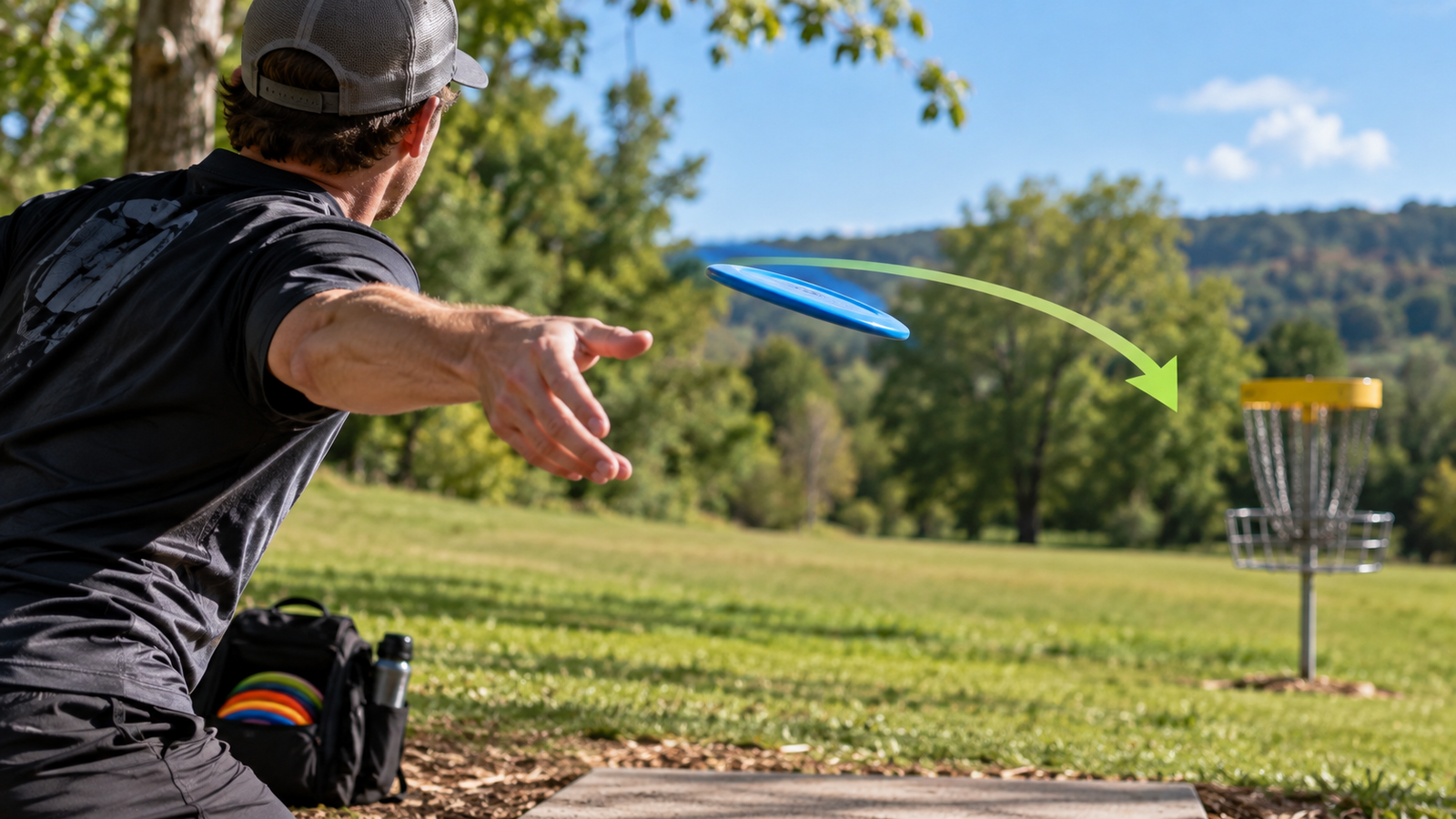
An anhyzer, or “anny” for short, is a shot where you release the disc with the outside edge tilted up instead of down. For a right-handed backhand thrower, that tilt sends the disc curving to the right. It’s the shot you reach for when a fairway bends the way your disc doesn’t naturally want to go, and once you can throw it on command, whole holes open up that used to feel impossible.
The angle itself is simple. Getting it to fly the way you want takes the right release, the right body position, and the right disc for the shot. Here’s how all three fit together.
What is an anhyzer shot?
An anhyzer is a release angle, not a type of disc. It describes how the disc is tilted at the moment it leaves your hand. Picture the disc from behind as you throw it. Flat is level with the ground. A hyzer tilts the outer edge down, like a backslash leaning left. An anhyzer tilts the outer edge up, the opposite way.
That tilt decides which way the disc curves out of your hand. A right-handed backhand disc thrown flat will fade left at the end. Tilt it to anhyzer and it starts by turning right instead. Left-handed players get the mirror image: their anhyzer curves left.
It helps to keep two separate angles clear in your head. The left-to-right tilt at release is what makes a shot a hyzer or an anhyzer. The front-to-back angle, called the nose angle, is a different thing entirely, and it controls how fast the disc climbs or drops. You can throw an anhyzer with the nose up or down, and getting the nose part wrong is one of the quiet reasons an anny comes up short. For now, just remember that anhyzer refers only to that sideways tilt of the outer edge.
The reason the anhyzer matters so much is that it lets one disc fly more than one line. The same midrange can go dead straight on a flat release, curl left on a hyzer, and swing right on an anhyzer. Learning to set the angle on demand is a big part of what separates a player who carries ten discs from one who can shape a dozen shots with three.
Quick check: outside edge down is hyzer, outside edge up is anhyzer. If you’re RHBH, anhyzer curves right.
How to throw an anhyzer, step by step
The grip does not change. You throw an anhyzer with the same backhand grip you already use, then adjust your wrist and body to set the angle. Work through these steps in order.
- Set your body to the line. Aim with your hips and plant foot, not the basket. Point them along the line you want the disc to travel, which means angling your stance a little more to the right than usual for a right-turning shot.
- Rotate your wrist like a doorknob. Hold the disc out in front of you and turn your palm up, as if you were opening a door. That single motion lifts the outside edge into the anhyzer angle. Keep the wrist itself straight and firm, not bent or contorted.
- Keep the nose down. The front-to-back angle still matters. A nose that points up will stall and fade early. Tilt the leading edge slightly down and hold it there through the pull.
- Pull straight, then release on the angle. Pull the disc in a straight line across your chest. Let it out on the tilt you set, and resist the urge to yank it back to flat at the last second. That urge is the single biggest thing that ruins the shot.
- Follow through on the same plane. Your arm should finish along the line the disc is flying. Follow through in the same direction you released, which keeps the angle clean and cuts the wobble that costs you spin and distance.
The wobble you sometimes see on release is off-axis torque, and it comes from applying force in a different direction than the angle you meant to throw. The fix is to keep the follow-through moving along the same line as the throw. Innova’s guide to common throwing errors walks through this in more detail.
The biggest mental hurdle is trust. An anhyzer looks and feels like the disc is about to crash right, and your instinct is to correct it by flattening out. Fight that instinct. A disc with the right stability will hold the turn and either drift where you aimed or fade back on its own. Set the angle, commit to it, and let the disc do the work you chose it for.
Which disc should you throw on an anhyzer?
Disc choice changes the shot more than almost anything else. The same anhyzer angle produces three very different flights depending on how stable the disc is. Match the disc to what you want the shot to do.
| Disc stability | What it does on an anhyzer | Best for |
| Understable | Holds the right turn for a long time, keeps drifting right | Long turnovers, rollers, beginners learning the angle |
| Stable | Turns right on the arc, then levels out and lands fairly straight ahead | Controlled right-finishing shots |
| Overstable | Turns right early, then fights back and fades left (the S-shaped flex shot) | Flex shots, windy conditions, big distance |
If you’re still learning the angle, start with a slower, understable midrange or fairway disc. A stable-to-understable mid gives you the turn at lower power, so you can feel the motion without fighting the disc.
Fast, overstable drivers are the hardest to turn over and will punish an early anhyzer with a hard fade, so leave them until the motion is second nature. Checking a disc’s turn and fade first helps, and the Innova flight ratings system explains what a disc’s turn and fade numbers actually mean.
When should you throw an anhyzer?
Reach for an anhyzer whenever the shot needs to move the way your fade won’t. A few clear situations come up again and again.
- A fairway that curves right (for RHBH). A hyzer fights the hole; an anny follows it.
- Trees blocking your left side, where you need to open a gap from a right angle instead of going straight through.
- Turnover shots, where you want the disc to hold a long, drifting right turn for extra distance.
- Rollers, where a sharp anhyzer sends the disc to the ground on its edge to roll down a tight fairway.
- Flex shots, where an overstable disc on anny gives you a long S-shaped line that finishes back to the left.
There’s also a choice to make between an anhyzer and a forehand, since both can send the disc right for a right-handed player. A backhand anhyzer usually gives you more distance and a softer finish, because the disc still fades a little at the end. A forehand tends to be flatter and more overstable. Pick the anny when you want that gentle right-to-left finish or when your forehand isn’t reliable enough for the gap.
One thing to watch is wind. A left-to-right wind will push an anhyzer over faster and can flip it into a roller before you want it. A right-to-left wind holds the disc up longer and can stall the turn. Wind makes discs act more understable in general, so a shot that turns nicely on a calm day may turn too much in a breeze. If it’s windy and you’re not confident, a hyzer is the safer play.
Common anhyzer mistakes and how to fix them
Most anhyzer problems trace back to a handful of habits. Here’s what tends to go wrong and the quick fix for each.
Bending or contorting the wrist. Twisting your wrist into an awkward shape kills your power and adds wobble. The angle should come from turning your palm up, not from breaking the straight line your wrist makes with your forearm.
Pulling the disc back to flat. It feels natural to level the disc at the last moment, which cancels the whole shot. Trust the angle you set and let it go on the tilt.
Nose up on release. A raised nose makes the disc stall and drop short. Tilt the leading edge down in your grip and keep the wrist flat through the hit.
Rounding the pull. If the disc wraps around your body instead of pulling straight, your release point gets inconsistent and you lose power. Keep your elbow up and pull along a straight rail toward the line.
Too much disc. An overstable driver simply won’t turn over for most arms and will fade hard left no matter how much anny you give it. Drop to a slower or more understable disc until the shot works.
How to practice the anhyzer?
Field work is where this shot gets built. Grab a stable-to-understable mid and a handful of discs, find an open field, and throw the same anny line over and over. Start at about 70 percent power so you can feel the release angle without muscling it, and only add power once the motion repeats cleanly.
Throw a few, then walk out and look at where they landed compared to where you aimed. If they’re finishing left, you’re either pulling back to flat or the disc is too overstable. If they’re screaming right into a roller, ease off the angle or drop to a stable disc. Adjusting one thing at a time, then reading the result, is how the shot becomes automatic.
A good drill is to throw the same disc at three different anhyzer angles, from a slight tilt to a steep one, and watch how the finish changes. That builds a feel for how much angle produces how much turn, which is exactly the control you want on the course. It also helps to film yourself from behind now and then.
What your arm actually does on release is often different from what it feels like, and seeing the disc leave your hand tells you fast whether the angle is clean or you’re rolling your wrist. A big field and a bit of patience beat any amount of reading.
Conclusion
To throw an anhyzer, keep your normal grip, turn your palm up like a doorknob to lift the outside edge, aim your body along the line, and release on that tilt without flattening it out. Pick a stable or understable disc while you learn, and pull straight with a matching follow-through.
A good anny curves smoothly the way you aimed and finishes where you wanted. Get out to a field, throw it repeatedly at easy power, and it will start to feel natural.
Frequently asked questions
What does anhyzer mean in disc golf?
Anhyzer is a release angle where the outside edge of the disc is tilted up at the moment you let go. For a right-handed backhand thrower, it makes the disc curve to the right, the opposite of a hyzer.
Do you change your grip for an anhyzer?
No. You use the same backhand grip. The angle comes from turning your palm up and setting your body to the line, not from changing how you hold the disc.
Which disc is best for an anhyzer?
A stable-to-understable midrange or fairway disc is best while learning. Understable discs hold the right turn easily, while overstable discs need more power and will fade back to the left.
Why does my anhyzer keep turning into a roller?
The disc is hitting the ground on its edge because the angle is too steep, the disc is too understable, or you threw with too much power. Ease off the tilt or move to a more stable disc.
Is an anhyzer or a forehand better for going right?
Both work for a right finish (RHBH). Choose the anhyzer when you want backhand distance and a bit of fade at the end, and the forehand when you need a flatter, more overstable line.
Related Articles
Mini G Wagon Golf Cart: Price, Specs, and Buying Guide
How Long Does Golf Take? 18 & 9-Hole Times Explained
Do You Remove the Shaft Sticker on Golf Irons?
Are Nitro Golf Balls Any Good? An Honest Look at the Budget Brand
[…] How to Throw an Anhyzer Shot in Disc Golf? […]
[…] How to Throw an Anhyzer Shot in Disc Golf? […]
[…] How to Throw an Anhyzer Shot in Disc Golf? […]