
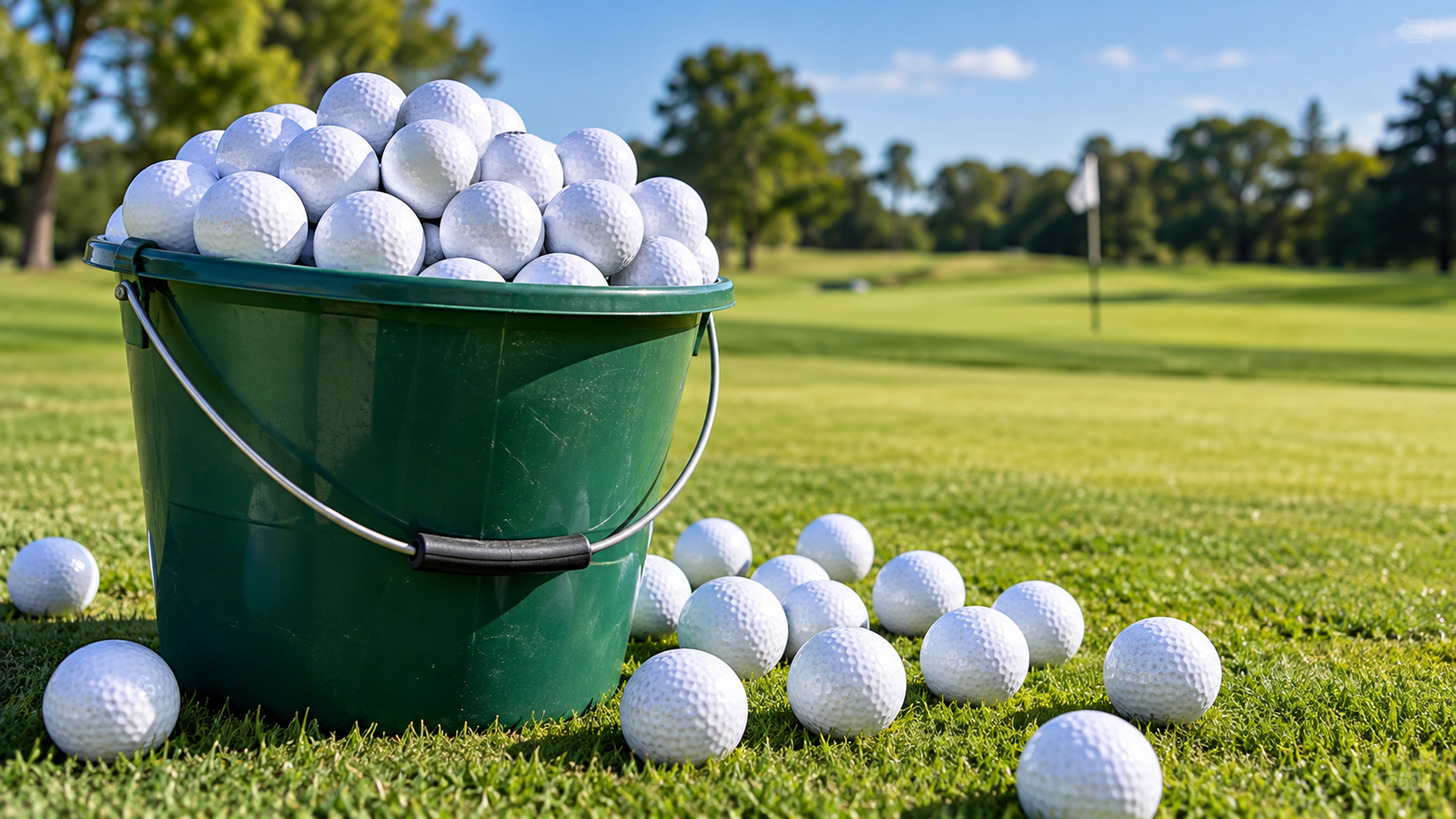
A small bucket at most driving ranges holds around 35 to 45 balls, a medium bucket holds about 70 to 80, and a large or jumbo bucket runs anywhere from 100 to 160. The exact count and the price both depend on the range, since there’s no industry standard bucket, and the same label can mean a different number of balls depending on where you go.
Here’s how the sizes break down, what you should expect to pay, how many balls you actually need to get something out of a practice session, and where the used ones end up once a range is done with them.
How many balls come in each bucket size?
Most ranges use a token machine that drops a set number of balls per size when you feed it a token or a card swipe. You’ll usually see three to five size options at the counter, and the categories tend to look like this:
- Extra small: about 25 to 30 balls, often scooped by hand into a small basket or sack rather than dropped by machine
- Small: about 35 to 45 balls
- Medium: about 70 to 80 balls
- Large: about 100 to 120 balls
- Jumbo or extra large: about 140 to 160 balls
Those numbers shift from range to range. One course might sell a small bucket of 35 balls for a few dollars, while another calls 70 balls its small size and skips the extra small option entirely. Some ranges only offer two sizes, a regular and a large, and leave out the extra small and jumbo tiers altogether.
If you want an exact count, ask at the counter. The dispensing machine is calibrated to a specific number, and staff usually know it off the top of their head, since it rarely changes once it’s set.
Bucket size also tends to track with how the range is set up. A stacked, multi-tier facility built around simulator bays or heated stalls often sells fewer size options, usually just a standard bucket good for one bay session, since golfers there are paying for the bay time rather than counting balls.
A traditional open-field range, where you’re standing on real turf or a mat and watching your own ball flight, usually offers the fuller lineup of sizes because ball count is the main thing you’re buying.
What a bucket of balls costs?
Expect to pay somewhere between $4 and $20, with most everyday ranges landing in the $5 to $15 range for a medium or large bucket. A small bucket of 35 to 45 balls often runs $4 to $8. A large bucket of 100 or so balls typically costs $10 to $16. Some ranges sell season passes or punch cards instead, letting you pay a flat daily rate, often $7 to $10, for unlimited large buckets during a visit.
Ball quality affects the price too. A range using fresher, better-conditioned balls will usually charge more than one running its machines on scuffed, well-worn stock.
Newer, higher-end facilities with launch monitors and heated bays tend to sit at the top of the price range regardless of ball count, since part of what you’re paying for is the technology and the roof over your head, not just the balls themselves.
Buying in bulk usually brings the per-ball price down. A punch card or loyalty account that preloads a set number of buckets, or a season membership that covers a fixed number of visits a month, both work out cheaper per swing than paying full price at the counter every time.
If you go often enough that the math works out, a membership can turn a $10 bucket into something closer to $5 or $6 once you average it over a season.
Why bucket size and pricing vary so much?
There’s no golf authority that sets bucket sizes, so every range makes its own call. A facility buys its own dispensing machine, sets it to release a certain number of balls per token, and prices that against what balls, labor, and mowing cost to run the operation. A range with expensive real estate or heavy foot traffic often prices buckets higher even if the ball count is about the same as a course down the road.
Weather and region matter as well. Ranges in areas with a short golf season sometimes charge more per ball to make up for months of low traffic, while a warm-climate range that stays busy year round can spread costs across more customers and charge less.
How many balls do you actually need for a good session?
A full bucket doesn’t automatically mean a better practice session. Instructors generally agree that quality beats quantity every time. If you go through 100 balls on autopilot, swinging the same way at the same target without adjusting anything, you’re mostly just getting tired. A shorter, focused session with a clear goal for each swing usually helps more than a jumbo bucket hit on repeat.
A reasonable target for most golfers is 40 to 60 balls for full swings, split across a few clubs, plus separate time on chipping and putting that doesn’t use the bucket at all. If you’re warming up before a round, 15 to 20 balls covering your wedges through driver is usually enough.
Save the bigger buckets for sessions where you’re actually working on a swing change or a specific shot, and stop once your focus starts to slip. Hitting the same mistake fifty times just grooves it in deeper.
Set one goal per bucket. Pick a single thing to work on, whether it’s ball position, tempo, or a fade, and hit every ball toward that one goal instead of switching targets every few swings.
There’s also a difference between practicing and just hitting balls. A block of 10 shots with the same club at the same target teaches your hands what one repeated motion feels like, but it doesn’t test whether you can actually reproduce that motion on demand.
Alternating clubs and targets every shot or two, the way you would out on the course, is slower to feel comfortable but tends to carry over to your scorecard better than grooving one swing in isolation. If you’ve only got one bucket to work with, splitting it between a block of repetition early and a mixed, random set of shots toward the end covers both kinds of practice in a single session.
None of this means big numbers are wrong for everyone. Some competitive players and tour professionals build their whole game around high-volume repetition and will happily go through several hundred balls in a day when they’re deep into a swing change. That approach works for someone with the time, the body, and the coaching to back it up. For most weekend golfers, though, a shorter, more deliberate session beats a marathon bucket almost every time.
What makes range balls different from the balls you play with?
The balls sitting in that bucket usually aren’t the same construction as what’s in your golf bag. Most driving ranges use limited or restricted flight balls, built with a lower compression core or a harder cover so they hold up to thousands of hits and don’t fly quite as far. Depending on the ball, that can mean 10 to 20 fewer yards compared to your usual ball on the same swing, so don’t judge your distance off a range session too closely.
Some ranges instead use first-quality balls stamped “Practice,” which are often the exact same construction as the retail ball but marked because of a minor cosmetic flaw, like an off-center logo or a paint blemish. These perform close to a normal ball but still aren’t meant for scorecard rounds.
If you ever want to check whether a specific ball model is legal for tournament play, Titleist’s support page on practice balls walks through how “Practice” and “X-Out” markings work, and the USGA’s List of Conforming Golf Balls shows which exact models are approved for competitions where that local rule applies.
High-tech driving ranges built around screens and tracking, the kind where every bay has a launch monitor and a leaderboard, often use their own branded ball with a microchip or a reflective marking baked in so the system can track flight and spin. Those balls are built for that specific setup and aren’t sold to the public, which is part of why you won’t see them anywhere but that one chain of venues.
Buying a bucket of used balls for home practice
Once range balls get too scuffed or cut up to hand out anymore, a lot of courses sell them off cheap instead of throwing them out. It’s common to find a 5-gallon bucket of retired range balls for $10 to $30, holding anywhere from 300 to 400 or more balls depending on how tightly they’re packed.
A standard golf ball is about 1.68 inches across, and a 5-gallon bucket can hold somewhere around 340 to 460 of them, so a full bucket goes a long way for chipping practice, a home net, or just knocking a few into a pond.
These balls are usually too rough for the course but still fine for a backyard mat, a chipping net, or teaching a beginner the basics of contact and swing path. Ask your local range or course pro shop if they sell off old stock. Many do, even if it isn’t advertised.
Conclusion
A bucket of golf balls can mean anywhere from 35 to 160 balls depending on the size and the range, and prices usually fall between $4 and $20. Rather than chasing the biggest bucket on the board, pick a size that matches what you’re actually working on, keep your focus sharp for every swing, and treat a jumbo bucket as something for a dedicated practice day rather than every visit.
Frequently asked questions
How many golf balls are in a large bucket?
A large bucket usually holds 100 to 120 balls, though some ranges stretch a large size up to 160. The exact count depends on how the range’s dispensing machine is set, so it’s worth asking at the counter if you want a precise number.
How many balls should I hit in one range session?
Most golfers get more out of 40 to 60 focused swings than a full jumbo bucket hit without a plan. Warm-ups before a round can be as short as 15 to 20 balls, while a dedicated swing-change session might justify more.
Are range balls different from the balls I play with?
Yes, in most cases. Range balls are often limited flight models built to survive heavy use, which can fly 10 to 20 yards shorter than your usual ball. Some ranges use first-quality “Practice” stamped balls instead, which perform closer to normal.
How much does a bucket of golf balls cost?
Expect to pay $4 to $8 for a small bucket and $10 to $20 for a large one at most ranges, though pricing varies by region, ball quality, and whether the facility offers launch monitors or other extras.
How many golf balls fit in a 5-gallon bucket?
A 5-gallon bucket holds roughly 340 to 460 golf balls, depending on whether they’re poured in loosely or packed more carefully. That’s the size commonly used for selling off retired range balls.
Related Articles
Do Golf Balls Go Bad? The Real Answer
Golf Scramble Rules: How to Play, Score, and Win
Golf Club Rentals: Cost, Options and How to Choose
What Is Par in Golf? A Clear, Complete Guide