
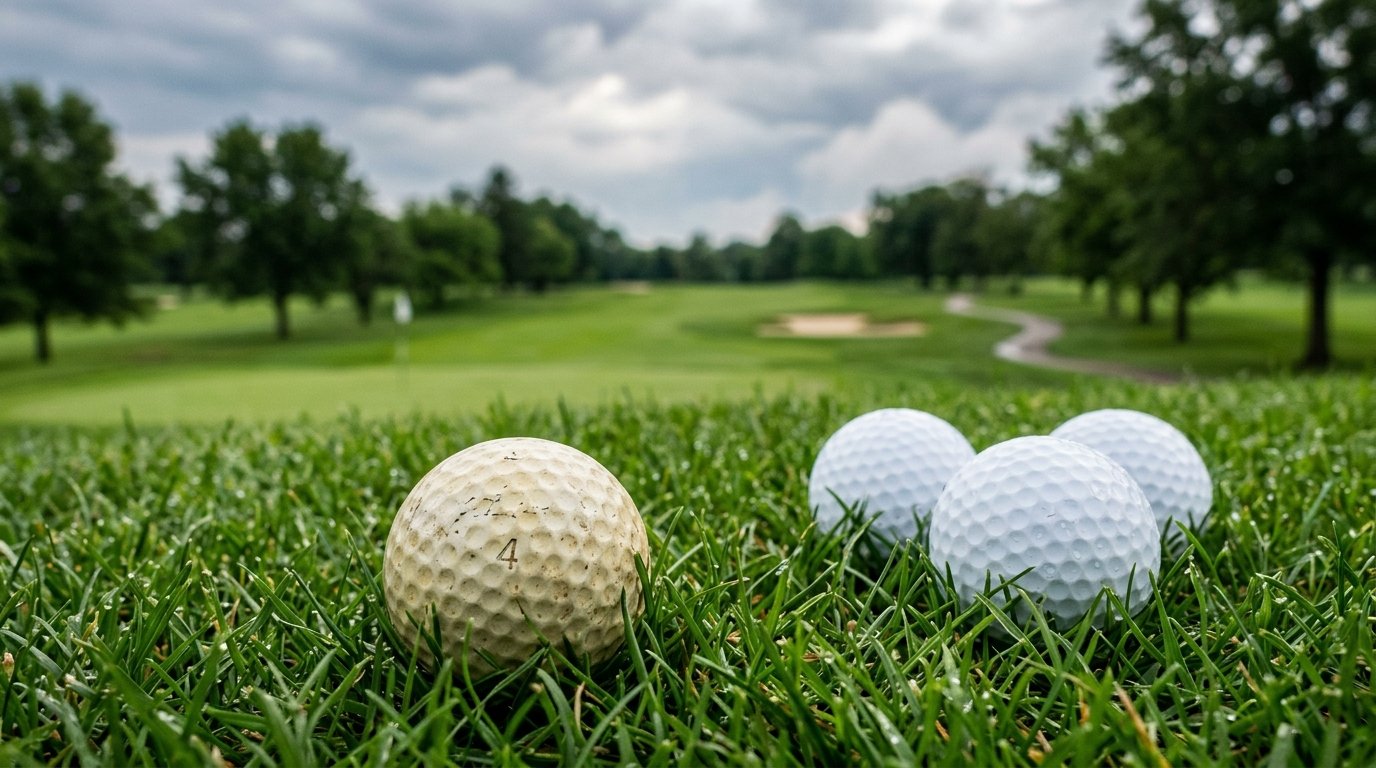
A golf ball sitting in a drawer for a few years is not going bad the way milk does. Modern balls are built from solid rubber and plastic, so age alone barely touches them. What actually wears a ball out is heat, physical damage, and, in rare cases, a cracked cover that lets water inside. Here is what really shortens a golf ball’s life, and what does not.
Do golf balls go bad over time?
Mostly, no. Today’s balls use a solid rubber core wrapped in one or more plastic or urethane layers, and that construction barely changes on its own. A dozen balls left on a closet shelf for five or six years will fly almost the same as they did the day you bought them.
That was not always true. Golf balls made before the early 2000s often used a liquid-filled center wound with rubber thread. That liquid core would slowly leak and evaporate, so the ball lost weight, shrank, and went out of round over a few years. If you ever find one of these old wound balls in an attic box, treat it as a keepsake, not something to play.
What actually wears out a golf ball on the course?
Play, not time on a shelf, does most of the damage. A single ball can survive several rounds if you are careful, but every strike against a cart path, tree root, or bunker rake leaves a small mark. Grooves from an iron or wedge cut into the cover on nearly every full shot, and those cuts add up.
Small scuffs barely change how a ball flies. A shallow scrape from the rough or a light scratch from a cart path costs almost nothing in distance or spin. The real damage shows up once a cut breaks through the cover into the layer underneath. At that point the ball can fly noticeably lower and shorter, and a hard hit can even push the spin axis off center, sending the shot well off line, sometimes by 30 or 40 yards from where you aimed.
A wet clubface makes this worse. Water on the face reduces the grip between the grooves and the cover, so instead of gripping the ball cleanly, the grooves tend to skid and cut into it. That is one reason a ball played in the rain often looks rougher after one round than a ball played in dry conditions for several.
Does the type of ball change how long it lasts?
Yes, a little. Golf balls are not all built the same way, and the cover material affects how fast one shows wear.
| Ball type | Cover material | How it wears |
| Two-piece distance ball | Surlyn (a tough ionomer plastic) | Very cut resistant, holds up well over many rounds |
| Tour ball (Pro V1 style) | Urethane, usually over three or four layers | Softer for more spin and feel, scuffs a bit more easily |
Neither type goes bad with age any faster than the other. The difference shows up during play, not on the shelf. A urethane tour ball scuffs a touch more easily against a cart path or bunker rake because the softer cover is what gives you that extra spin around the greens. A surlyn distance ball trades some of that spin for a cover that shrugs off the same contact with barely a mark. If you are hard on your equipment, a durable two-piece ball will simply show less wear over the same number of rounds.
Does heat damage golf balls?
Yes, and this is the fastest way to wreck a ball. Warm temperatures soften the rubber core, which changes how the ball compresses at impact. A ball left in a car trunk or an attic through a summer can sit well above 100 degrees Fahrenheit for hours at a time, and repeated heat like that speeds up the breakdown of the core and cover.
Keeping golf balls between roughly 60 and 80 degrees Fahrenheit is the safest range. Titleist’s own golf ball engineering team has said that a modern ball can be stored safely for five years or more, as long as it stays away from excessive heat. The trunk of a car in July is exactly the kind of place to avoid.
Does cold or freezing hurt a golf ball?
Not the way most golfers assume. Ball decay happens through a slow chemical reaction with oxygen in the air, and that reaction runs slower in the cold.
Testing at the USGA Research and Test Center compared a ball kept in a freezer for 14 years against an identical ball stored at room temperature for the same stretch. The room-temperature ball lost about one percent of its original speed. The frozen ball lost less than half a percent.
A ball stored in a freezer for 14 years actually held its speed slightly better than one kept at room temperature the whole time.
None of this means you need to keep your golf balls on ice. Cold storage does not hurt a modern ball, but it will not meaningfully help your game either, and a very cold ball does feel harder and less forgiving off the clubface until it warms back up. Extreme heat is the real threat. Extreme cold just is not.
Can a golf ball get waterlogged?
Only if the cover is already broken. An intact modern cover is essentially waterproof. Balls pulled from ponds after sitting underwater for a month, three months, even five months show almost no change in ball speed, spin, or carry distance in robotic testing, because the outer layer keeps water out of the core the whole time.
A cracked or deeply cut cover is a different story. Once the seal is broken, water can soak into the core in as little as six hours, adding weight and dulling the feel at impact. A ball in that condition will not fly the way it should, no matter how long it sat in the water. So the real question is never how long a ball was wet, but whether the cover is still whole.
How long do new, unopened golf balls last?
A sealed box or sleeve, stored indoors at normal room temperature, holds up well for five years and often longer. The core and cover barely change under those conditions, and the seal on the box or sleeve keeps out moisture and dust.
The one thing that does change over five years is not the ball itself, but the technology around it. Manufacturers update their models every couple of years, so a box that has been sitting since an older release will not have whatever small aerodynamic or spin improvements came after it. The ball will still perform close to its original spec. You just might be leaving a small, modern upgrade on the table.
Signs a golf ball has actually gone bad
Most golf balls in a bag are fine. Watch for these signs when you are deciding whether to keep one in play:
- A visible crack or split in the cover. Once the outer layer is broken, moisture and air can reach the core.
- An out-of-round shape. Roll the ball on a flat, level surface. If it wobbles instead of rolling smoothly, the core or layers have shifted or deformed.
- A dull, dead thud on contact instead of a crisp sound, often paired with a noticeable drop in distance.
- Deep scuffs or scrapes that cut through the cover, not just surface marks. These change the ball’s flight and can cost real distance and accuracy.
- Heavy discoloration paired with a soft or mushy feel, which usually points to sun and heat exposure over a long period.
A ball with light scuffing, a bit of grass staining, or a faded logo is still a perfectly good ball. None of those affect performance in any way you would feel on the course.
Are used or “lake” balls safe to play?
Generally, yes, as long as the cover is intact. Retailers that sell recovered balls grade them by condition, from mint, barely used, down through visible wear, and a ball in the top two or three grades performs close to identical to a new one in independent testing. The cover, not the time spent in the water or the bag, is what determines whether a used ball is worth playing.
Cheap, deeply scuffed practice balls are a different category. Those are fine for the range but not for a round where distance and spin control matter.
How to store golf balls the right way?
A little care makes any set of balls last years longer:
- Keep them indoors, ideally between 60 and 80 degrees Fahrenheit.
- Avoid the trunk of a car and an uninsulated garage or attic during hot months.
- Keep them dry and out of direct, prolonged sunlight.
- Store them in their original box or sleeve when you can, since the packaging blocks dust and light.
- Retire any ball with a cracked or deeply cut cover, no matter how new it looks otherwise.
Conclusion
Modern golf balls do not go bad from age the way old wound balls once did. Heat, physical damage, and a broken cover are what actually shorten a ball’s life, not the calendar. Store your balls indoors, away from hot cars and attics, retire anything with a cracked cover or an off-round shape, and a dozen balls bought today will still play well years from now.
Frequently asked questions
How long do unopened golf balls last in the box?
Around five years or more when stored indoors at normal room temperature, based on manufacturer testing. The seal keeps out moisture, and the core barely changes without heat exposure.
Is it bad to leave golf balls in a hot car?
Yes. Temperatures above roughly 80 degrees Fahrenheit soften the core, and a car trunk in summer sun can run far hotter than that for hours at a stretch. Repeated exposure speeds up wear.
Does freezing damage golf balls?
No. Cold storage does not harm a modern ball’s core or cover, and long-term testing has shown little to no performance loss from freezing temperatures alone.
Can you play a golf ball you found in a pond?
Yes, as long as the cover has no cracks or deep cuts. An intact cover keeps water out of the core for months, so a clean, uncracked ball performs close to a new one.
How do you know when to replace a golf ball?
Replace it when you see a crack, an out-of-round shape when rolled on a flat surface, a dull thud on contact, or a scuff deep enough to cut through the cover.
Related Articles
Golf Scramble Rules: How to Play, Score, and Win
Golf Club Rentals: Cost, Options and How to Choose
What Is Par in Golf? A Clear, Complete Guide
JumboMax Golf Grips: What They Do and Who They’re For
[…] Do Golf Balls Go Bad? The Real Answer […]
[…] Do Golf Balls Go Bad? The Real Answer […]