
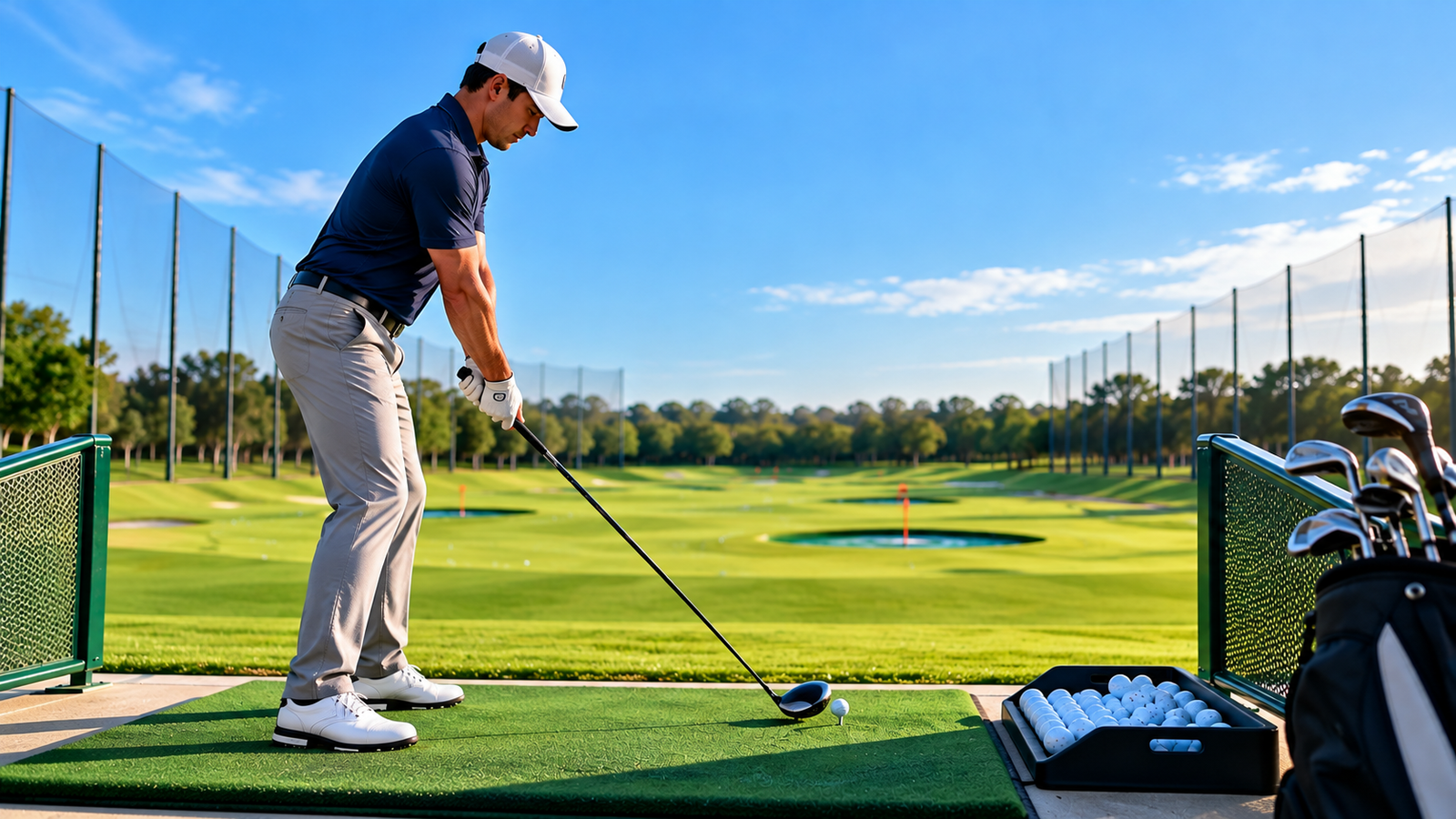
A golf driving range is a place where you can hit golf balls toward marked targets without playing a full round. It gives beginners room to learn the basics and helps experienced golfers work on distance, accuracy, and consistent contact. Most facilities have hitting bays, buckets of balls, and targets at different distances. Some also offer lessons, club fitting, putting greens, or indoor simulator bays.
Your first visit can be simple: buy a bucket, choose an available station, and start with short, controlled swings. A little planning makes the session safer, less stressful, and more useful.
What is a golf driving range?
A golf driving range is a practice area designed for hitting repeated shots from a set position. Golfers aim toward flags, distance signs, target greens, or nets. Unlike a golf course, you do not move from hole to hole or keep a score. You can focus on how you strike the ball and where it travels.
Ranges may be attached to golf courses or operate as standalone businesses. Some are open-air fields with long ball-flight areas, while others use covered bays or indoor screens. Many welcome people who have never played golf, and you usually do not need a tee time just to hit balls. Check the facility’s website or call ahead if you are unsure about access, hours, or equipment rental.
What should you expect on your first visit?
Most ranges make the process straightforward. Start at the front desk, pro shop, or ball machine and ask how to buy a bucket. Some facilities sell small, medium, and large buckets; others charge by the number of balls or by the time you use a bay. Staff can usually explain how the dispenser works and which stations are open.
Take your bucket to a marked hitting bay. Set your bag behind or beside the hitting area, and keep your clubs and other items out of the way of nearby players. If the range supplies rubber tees or has an automatic tee system, follow the posted instructions. Begin with a wedge or short iron rather than trying to hit the longest shot you can manage.
You do not need a complete set of clubs to start. If you have no equipment, ask whether the facility rents clubs. Wear comfortable clothes and shoes that give you a stable stance. Golf shoes are helpful but rarely essential for a casual first session.
What equipment should you bring?
Bring a few clubs, a glove if you use one, and a tee for your driver. A wedge, a mid-iron such as a 7-iron, and a driver are enough for a basic session. Add a hybrid or fairway wood if you want to practice longer shots. You do not need to carry every club in your bag when you are learning.
A small towel can help keep your hands and club grips dry, and water is useful during warm weather. If you have alignment sticks, bring them to check your aim, but a spare club laid safely on the ground can serve as a simple guide. Most important, decide on one goal before you start. For example, you might focus on making solid contact with a 7-iron or starting the ball toward a chosen target.
How much does a golf driving range cost?
The price depends on the location, bucket size, hitting surface, and extra services. In many parts of the United States, a basic bucket may cost around $6 to $25, with premium entertainment venues, major cities, and high-end practice facilities sometimes charging more. These are broad planning estimates, not a guaranteed local price. Check the current rates before travelling.
A small bucket is often the best choice for a first visit. You can learn the setup and see how your body feels without paying for more balls than you can use well. If you plan to practice regularly, ask about prepaid cards, memberships, off-peak rates, or lesson packages. A lesson costs extra, but a qualified instructor may help you avoid building habits that are difficult to change later.
Remember that the cheapest bucket is not automatically the best value. A nearby range with clear targets, safe bays, and well-kept mats may be more useful than a cheaper facility that is crowded or poorly maintained.
How should you practice at a driving range?
A productive range session has a purpose. Instead of hitting every ball as quickly as possible, choose a target and watch what each shot does. Notice whether the ball starts left or right, how high it flies, and whether contact feels clean. You do not need perfect shots to learn; you need to pay attention to patterns.
Try this simple routine for a bucket of about 50 to 60 balls:
- Warm up with 5 to 8 easy wedge shots. Make smooth half-swings and gradually increase the motion.
2. Hit about 15 balls with a mid-iron. Focus on one basic point, such as balance or making contact with the ball before the ground.
3. Hit about 15 shots at different targets. Change clubs or targets so you practise aiming, not just repeating one movement.
4. Use around 10 balls with a driver or fairway wood. Aim for a wide imaginary fairway rather than trying to hit every ball as far as possible.
5. Use the remaining balls to play imaginary holes. Picture a tee shot, then choose an iron for the next shot and go through your normal setup routine.
Take a short pause between shots. Reset your feet, choose the target, and make a practice swing if that helps you. If your contact gets worse because you are tired, stop or take a break. More swings are not always better when your attention has faded.
Are range balls different from regular golf balls?
Yes. Range balls are designed to handle repeated use, collection, and cleaning. Their construction and wear can make them fly differently from the golf balls you use on a course. Some ranges also use limited-flight balls because the available space is small. As a result, a shot’s distance on the range may not match its distance during a round.
Use the range to learn your general shot shape and improve contact, but be careful about treating every distance marker as an exact club-distance measurement. Wind, temperature, the ball itself, and the hitting surface all affect the result. If a range has a launch monitor or ball-tracking system, it may give you more useful feedback, though the quality and features vary by facility.
What is the difference between grass and mat hitting areas?
Grass tees let you hit from a surface closer to a real fairway, and they can provide clear feedback when your club strikes the ground before the ball. However, grass areas need time to recover and may be closed when conditions are wet or maintenance is underway.
Mats are durable and allow ranges to stay open in more conditions. They can be useful for practicing alignment, rhythm, and ball flight, but a firm mat may hide some poor contact because the club can bounce into the ball. If you practise on mats, pay attention to the strike’s sound and feel, and avoid repeatedly hitting down hard if your hands or wrists start to hurt.
On grass, follow the facility’s divot rules. Some ranges ask golfers to take divots in a narrow line rather than scattering them across a wide patch. That helps the turf recover and keeps the practice area usable for others. The USGA’s advice on making straight, narrow divots explains why the pattern matters.
What driving range etiquette should you follow?
Range etiquette keeps everyone safe and gives other golfers room to practise. Follow posted rules, and ask staff if anything is unclear. The most important habits are simple:
- Stay behind the hitting line and never walk onto the field to retrieve balls. Staff use equipment to collect them, and players may be hitting from several bays at once.
- Aim only toward the designated range area. Never hit sideways or toward another person.
- Leave space between your swing and other golfers. Check your surroundings before each shot, especially when carrying a club behind you.
- Do not step into another bay or pick up someone else’s clubs without permission.
- Keep your voice and phone calls considerate. Avoid giving unsolicited swing advice to strangers.
- Return baskets and rental clubs where the facility asks you to put them.
If a club slips, a ball moves unexpectedly, or you notice someone entering the range area, stop and alert staff rather than continuing to hit.
How do you choose the right golf driving range?
Choose a range that suits your current goal. Beginners may prefer a welcoming facility with rental clubs, clear instructions, and a quieter time of day. Golfers working on accuracy may value visible targets and enough space to see ball flight. Players preparing for a round may want a grass tee, putting green, chipping area, or practice bunker.
Check the basics before you go: opening hours, bucket prices, whether clubs are available to rent, and whether the facility uses mats or grass. If you want lessons, look for instruction from a qualified golf professional and ask about the lesson length and cost. For indoor practice, check whether the simulator measures ball flight and whether bay rental includes balls or a set time.
Convenience matters, too. A range you can visit consistently may help more than a distant facility with expensive extras. Start with what you need, then try other ranges if you want more advanced feedback or practice options.
Can a driving range help you improve at golf?
A driving range can help you improve your swing, make better contact, and learn how far your clubs tend to travel. It is especially useful for practising a specific skill without the time and pressure of a full round. But improvement depends on how you practise, not simply on how many balls you hit.
To make progress, keep a short record after each session. Note the club you used, the target, and the pattern you saw. Avoid changing several parts of your swing at once. If a problem keeps returning, a lesson can help you identify the cause rather than guessing at a fix.
Range practice also has limits. It does not fully recreate uneven lies, putting, chipping under pressure, course strategy, or the need to recover after a poor shot. Combine range sessions with short-game practice and time on a course when you can.
Conclusion
A golf driving range offers an easy place to start learning golf or sharpen skills before a round. Choose a facility that fits your budget, begin with a small bucket, and work toward clear targets instead of swinging without a plan. Follow the safety rules, allow time to rest, and use each shot to learn something about your contact and direction. Consistent, focused practice is more useful than simply hitting the largest number of balls.
Frequently asked questions
What should a beginner do at a golf driving range?
Start with a small bucket, use a wedge or short iron, and make easy swings before trying longer shots. Pick a visible target for each ball and ask staff about rental clubs or basic instruction if you need help.
How many golf balls should I hit at the range?
A beginner can start with about 30 to 50 balls, while a focused session of 50 to 60 can suit many golfers. Stop when your technique or concentration fades instead of forcing yourself to finish the bucket.
Can I go to a driving range without golf clubs?
Many facilities rent clubs, but availability varies. Call ahead to confirm rental options and ask whether the price includes balls. If you are borrowing clubs, a wedge or mid-iron is enough for a first session.
How long should a driving range session last?
A session of about 30 to 60 minutes is enough for many recreational golfers. Warm up, work on one goal, and take breaks as needed. Longer sessions are not helpful if fatigue causes rushed or uncomfortable swings.
Do driving range balls go as far as normal golf balls?
Not always. Range balls are built for repeated use and may have different flight characteristics, while limited-flight balls are designed to travel less. Use range distances as a guide rather than an exact measure of on-course club distance.
Related Articles
How Wide Is a Golf Cart? Widths by Model & Seats
What Does Scratch Golfer Mean? Handicap 0.0 Explained
What Is a Scramble in Golf? Rules, Handicaps & Tips
What Is a Mid Handicap Golfer? Range, Scores & Tips
[…] Golf Driving Range: Beginner Guide and Practice Tips […]
[…] Golf Driving Range: Beginner Guide and Practice Tips […]
[…] Golf Driving Range: Beginner Guide and Practice Tips […]