
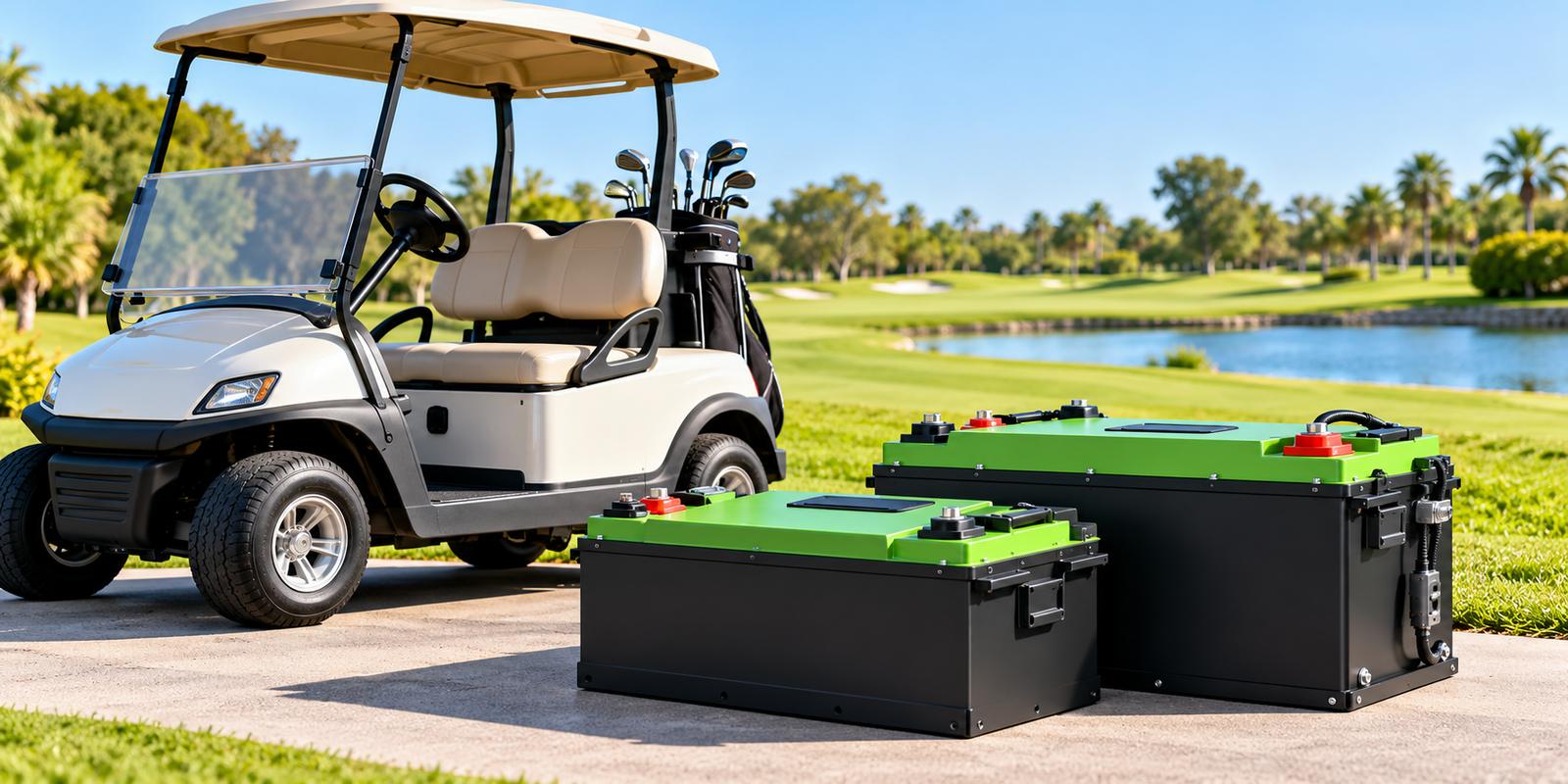
A 48V lithium golf cart battery is a single lithium iron phosphate (LiFePO4) pack that replaces the four, six, or eight lead-acid batteries in your cart. It costs more up front, usually $1,800 to $4,500 installed, but it lasts 8 to 12 years, needs no watering, and can take 200 pounds or more out of the cart.
For most people who drive their cart often, that makes lithium the cheaper choice over time. The right pack depends on your cart model, how far you drive, and how cold your winters get. This guide explains what you are buying, what it costs, what size to pick, and how to charge it safely.
What is a 48V lithium golf cart battery?
It is a rechargeable pack built from lithium iron phosphate cells, known as LiFePO4. Sixteen cells are wired in a row, which makes a pack that reads 51.2 volts on the label. Your cart sees it as a normal 48V system, so the motor and controller stay the same.
Inside the case is a battery management system, or BMS. It is a small circuit board that watches the voltage and temperature of every cell. It shuts the pack down if it gets too hot, too cold, overcharged, or drained too low. It also keeps the cells balanced so they wear evenly.
Packs come in two main styles. A single large pack, often rated 100Ah, replaces your whole set with one box about 20 inches long, 10.5 inches wide, and 8.5 inches tall. A GC2-size pack matches the size of a standard lead-acid battery, so it fits the original tray. Each one is already 48V, and you wire two or three together in parallel, which adds capacity and keeps the voltage the same.
To work out how much energy a pack holds, multiply volts by amp-hours. A 51.2V, 100Ah pack holds 5.12 kilowatt-hours (kWh).
Before you shop, confirm your cart really is 48V. Open the seat and add up the old batteries. Six 8V batteries, four 12V batteries, or eight 6V batteries all make 48 volts. A 36V cart needs a 36V pack, and a 72V cart needs a 72V pack, so a 48V pack will not work in either.
How do lithium and lead-acid golf cart batteries compare?
Lithium wins on life, usable power, and upkeep. Lead-acid wins on price at the checkout.
| Lithium (LiFePO4) | Flooded lead-acid | |
| Typical life | 8 to 12 years | 3 to 5 years |
| Charge cycles | 2,000 to 5,000 | 500 to 1,000 |
| Usable capacity | 90 to 100 percent | About 50 percent |
| Charging efficiency | Over 95 percent | 75 to 85 percent |
| Upkeep | None | Watering, terminal cleaning |
| Weight | 200+ pounds lighter | Heavy |
| Installed cost | $1,800 to $4,500 | $700 to $1,700 |
Usable capacity matters most in daily driving. A lead-acid set gives you about half of its rating before it needs a recharge. A lithium pack lets you use 90 percent or more, so a smaller lithium pack can often go as far as a bigger lead-acid set.
Lead-acid also loses voltage as it empties, so the cart slows on hills near the end of a charge. Lithium holds its voltage until it is almost empty, so the cart pulls as hard on hole 18 as it did on hole 1. The lost weight helps too, because a lighter cart pulls away faster.
Life spans in the table are ranges, not promises. How you use the pack moves the number. Deep drains, constant fast driving up hills, high heat, and an ill-matched charger all wear cells faster. Regular charging, shade, and the right charger help a pack reach the top of its range.
Lead-acid still makes sense for a cart that gets light, occasional use, or one you plan to sell soon.
How much does a 48V lithium golf cart battery cost?
A lithium pack costs $1,800 to $4,500 installed in 2026, including labor and disposal of the old batteries. A flooded lead-acid set costs $700 to $1,700 installed. The spread in lithium prices comes from capacity, brand, and what is in the box.
A small 27Ah GC2 module starts near $800, but you need two or three to run a cart. A 100Ah kit with a charger usually lands between $1,600 and $2,900.
Four things move the price most: the amp-hour rating, the maximum current the BMS allows, extras like a heated pack or Bluetooth monitor, and the length of the warranty. A heated pack costs more than a standard one, so only pay for it if you charge in freezing weather.
The better number is cost per year. Say you pay $1,200 for a lead-acid set that lasts four years. That is $300 a year. A $2,400 lithium pack that lasts ten years is $240 a year, and you skip two battery swaps, the watering, and the corroded terminals.
Check what the kit includes before you compare prices. A kit with the charger, monitor, brackets, and 12V converter saves you from piecing parts together. Buying them one by one adds cost and fit problems.
These are US prices, and they vary by dealer and region. Lithium packs weigh too much for parcel shipping, so they travel as freight, and delivery to a home address can add a fee.
What size lithium battery do you need?
Amp-hours (Ah) show how much energy the pack holds. More Ah means more range, more weight, and a higher price. These sizes cover most carts:
- 72Ah: light use and short trips. It covers about 36 to 45 holes, plus the drive to and from the course.
- 100Ah to 105Ah: the most common size. It covers about 54 holes, plus the drive to and from the course.
- 150Ah and up: hilly ground, big tires, extra seats, or daily rental use.
Real range depends on terrain, speed, tire size, and weight. A cart full of passengers on steep ground uses far more power than a solo driver on a flat course.
Bigger is not always better. A larger pack adds weight and cost, and it may not fit your tray. If you drive short distances, a 100Ah pack gives you more range than you will ever use.
Size the pack for your longest regular day, not your average one. Lithium does best when you recharge before it drops below 20 percent, so leave yourself some room.
Will a 48V lithium battery fit your golf cart?
Many 48V carts from EZGO, Club Car, and Yamaha can run lithium, though older carts may need a closer look at the controller and wiring. An EZGO RXV uses four 12V batteries and a TXT uses six 8V. A lithium kit replaces all of them with one pack. Check these four things before you order:
- Tray space. Measure your battery bay. A single large pack may need a bracket or adapter made for your cart model.
- Charger. Lithium needs its own charger. The factory charger in an EZGO RXV is built for lead-acid and will not work. Club Car owners should ask whether the kit needs any change to the cart’s on-board computer.
- Cables and controller. Replace old or corroded cables. If you have a bigger motor, a higher-amp controller, large tires, or extra seats, ask for thicker cables and make sure the pack’s current rating covers the load.
- 12V accessories. Lights, horns, and stereos need a 48V-to-12V DC converter.
Take a photo of your wiring before you pull the old batteries out. It makes reconnecting much easier. If a seller cannot tell you whether a kit fits your model and year, buy from one that can.
How do you install a 48V lithium battery in a golf cart?
A conversion takes a few hours with basic hand tools. The steps below suit most carts, but follow the instructions that come with your kit, since wiring differs by model.
- Turn the key off, set the tow/run switch to tow, and disconnect the main negative cable first.
- Photograph the wiring, then label and remove the old batteries and cables.
- Set the lithium pack in the tray and secure it with the brackets so it cannot slide.
- Connect the main positive and negative cables, then wire in the monitor and the 12V converter.
- Fit the lithium charger plug or receptacle, and charge the pack fully before the first drive.
Watch the first charge closely. If the charger switches on and off, finishes far too fast, or trips the BMS, the charging profile is wrong. Stop and check the setup before you charge again. If any step makes you unsure, a dealer can do the job quickly.
What should you look for in a good pack?
Start with the BMS. A good one protects against short circuits, over-current, overcharging, over-discharging, and high and low temperatures. Check its continuous current rating too. Many 100Ah packs list 200 amps.
Next, ask about safety certification. UL 2271 is the standard for battery packs in light electric vehicles, a group that includes golf carts. It tests how a pack handles abuse such as overcharging, short circuits, and rough vibration. It does not measure how long a pack will last or how far it will go. Cells that carry a UL listing do not make a UL 2271 pack, so ask for the certificate covering the finished battery.
Cell chemistry matters as well. LiFePO4 handles heat and overcharging better than other common lithium types, so stay with it for a golf cart.
Finally, look at the extras. A monitor or Bluetooth app shows charge level, voltage, and temperature. The warranty should be long and plainly written, and it should say what voids it, such as using another brand’s charger. Install help by phone or video is worth having if this is your first conversion.
How do you charge and look after lithium golf cart batteries?
Use the charger made for your pack. A 48V LiFePO4 pack charges to 58.4 volts, and a lead-acid charger follows a different curve. The wrong charger can damage the pack and may void the warranty.
To estimate charge time, divide the pack’s amp-hours by the charger’s amps. A 100Ah pack on a 20-amp charger takes about 5 hours from empty. Short top-ups are fine for lithium, and they do not wear it the way they wear lead-acid. Charge after each use, and before the pack falls below 20 percent.
Cold is the main rule to remember. You can drive a lithium cart in freezing weather, and many packs keep running down to about -4°F. But charging below 32°F (0°C) can plate metal lithium inside the cells and damage them for good. A good BMS blocks charging until the pack warms up. If your winters are cold, a heated pack warms its own cells before it charges, and this charging FAQ shows how one maker handles it.
Heat ages cells too, so park in the shade and avoid charging in direct sun.
You can leave the charger plugged in if you plan to drive again soon, which gives the BMS time to balance the cells. If the cart will sit for several days, unplug the charger.
For storage, charge the pack above 50 percent, switch it off, and top it up at least every six months. Keep it dry, wipe it with a damp rag, and skip the pressure washer.
Conclusion
A 48V lithium golf cart battery costs more at the start but usually costs less over a decade. It lasts 8 to 12 years, weighs far less, and needs no upkeep. Size the pack for your longest regular day, and 100Ah suits most carts. Confirm it fits your model, choose a pack with a solid BMS and UL 2271 certification, and use the charger made for it. Never charge it below freezing unless it is a heated model.
Frequently asked questions
How long does a 48V lithium golf cart battery last?
Most last 8 to 12 years, or about 2,000 to 5,000 charge cycles, when charged correctly. A lead-acid set usually lasts 3 to 5 years. Heat, deep drains, and the wrong charger shorten the life of any battery.
Can I use my old lead-acid charger on a lithium battery?
No. Lead-acid chargers follow a different charging curve, and a 48V lithium pack needs a charger that finishes at 58.4 volts. The factory charger in an EZGO RXV, for example, is not lithium compatible. Use the charger sold with your pack.
How far can a 48V 100Ah lithium golf cart battery go?
A 100Ah to 105Ah pack covers about 54 holes plus the drive to and from the course. Hills, big tires, high speeds, and extra passengers all cut that number, so size the pack for your hardest day.
Can I install a lithium golf cart battery myself?
Many owners do. Most kits need basic hand tools: remove the old batteries, set the new pack, wire it, and add the monitor and 12V converter. Photograph your wiring first. If electrical work worries you, use a local dealer.
Can I drive and charge a lithium golf cart battery in cold weather?
You can drive it in freezing weather, though range drops. You cannot charge a standard pack below 32°F (0°C) without risking damage. Warm the pack indoors first, or buy a heated model that warms itself before charging.
Related Articles
Golf Cart Maintenance: What to Do and How Often
How Many Clubs Are in a Golf Set?
Is the 357 Golf Club Worth It?
[…] 48V Lithium Golf Cart Batteries: How to Choose the Right One […]
[…] 48V Lithium Golf Cart Batteries: How to Choose the Right One […]