
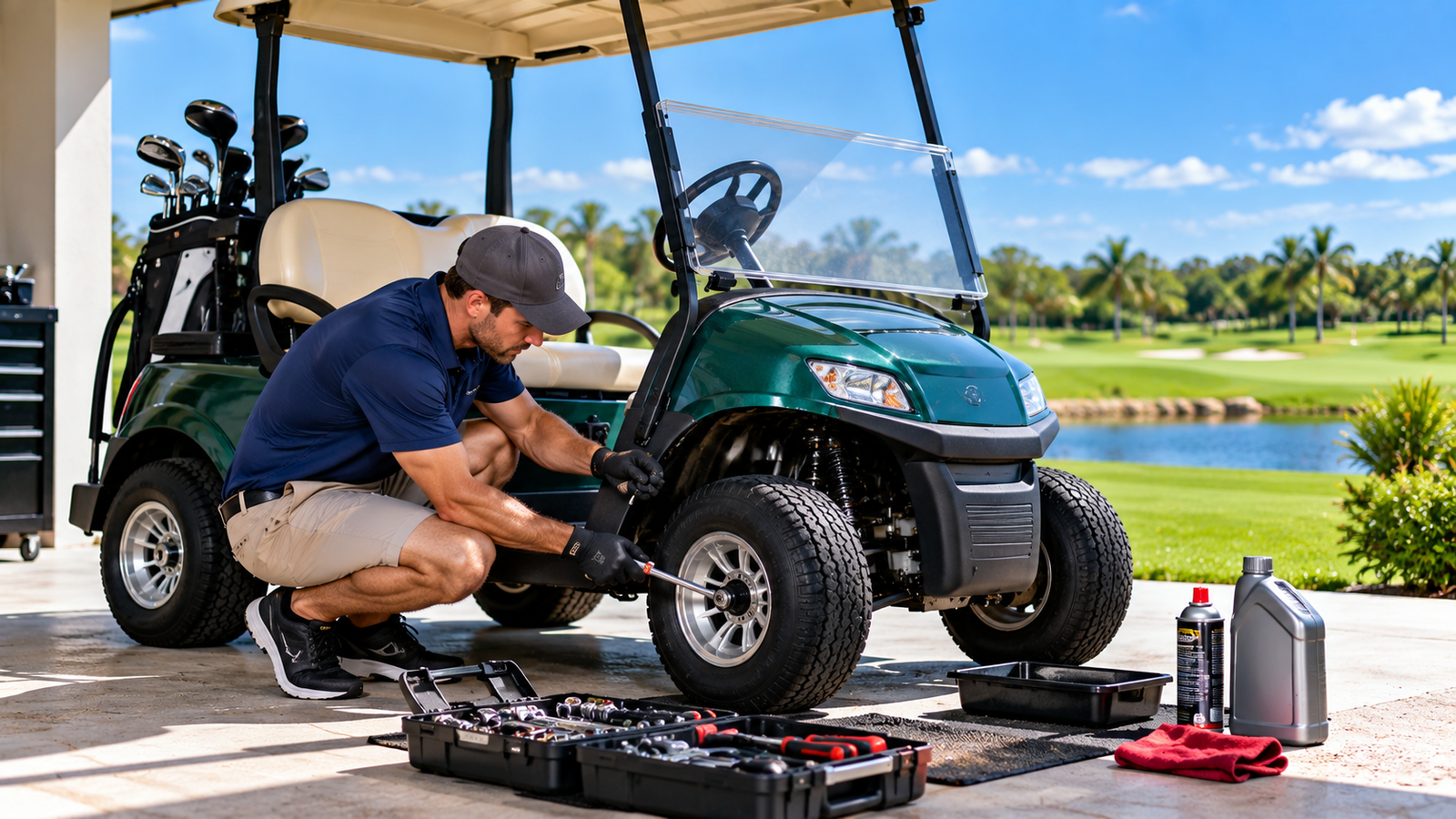
Golf cart maintenance is a short routine. Charge an electric cart after every use, check the battery water each month, test the tires and brakes, and book a full service every 6 to 12 months. Gas carts add oil, filter, and spark plug changes to that list.
Do these jobs on time and a cart can run for many seasons without a big repair bill. Skip them and small problems pile up: weak batteries, worn tires, and brakes that fade. Most of the work takes minutes, and you can do it yourself with basic tools.
This guide starts with a schedule. Then it covers electric carts, gas carts, tires and brakes, and winter storage.
How often should you service a golf cart?
Plan on a full service every 6 to 12 months, or every 100 to 200 hours of use, whichever comes first. Between services, do a quick check each week and a longer one each month.
| When | Time | What to do |
| Every week | 5 minutes | Walk around the cart. Check tire pressure, test the lights and horn, look under the cart for leaks, and wipe off dirt. |
| Every month | 15 to 30 minutes | Electric: check battery water, clean the terminals, and make sure the cables are tight. Gas: check the oil and look at the air filter. Both: test the brakes. |
| Every 3 to 6 months | 30 minutes | Inspect the brakes, grease the suspension and steering joints, and look over cables, belts, and bolts. |
| Every 6 to 12 months | Half a day at a shop | Full service: battery test, brake adjustment, electrical check, and front-end alignment. Gas carts also get new oil, filters, and a spark plug check. |
Hours matter more than dates if you drive a lot. A cart that works every day on hilly ground needs service sooner than one that takes a short trip once a week.
Your owner’s manual lists the exact intervals for your model. Club Car owners can find theirs in the Club Car manuals library.
What maintenance does an electric golf cart need?
An electric cart needs three things most: a full charge after each use, the right water level in the batteries, and clean, tight connections. The battery pack is the most costly part of the cart, so most of your effort goes here.
Charge it the right way
Plug the cart in after every ride, even a short one. Let the charger finish on its own and shut off. Cutting a charge short leaves the batteries out of balance, and that wears them out faster. If you can, plug the charger into a surge-protected outlet.
Try not to run the batteries down hard. Shallow discharges give a battery a longer life than deep ones.
Check the water in lead-acid batteries
Flooded lead-acid batteries (the kind with removable caps) lose water as they charge. Open the caps and look at every cell once a month. Check more often if you drive daily. The water must always cover the plates inside.
For many batteries the right level is about one-eighth of an inch below the bottom of the vent well, so read your battery label. Use distilled water only, and add it after a full charge. Water added before charging can bubble over, and an overfilled battery loses strength. Press the caps back on firmly.
Keep terminals clean and tight
Corrosion looks like white or blue powder on the posts. It adds resistance, which cuts your range and can overheat a connection.
Once a month, mix one cup of baking soda into one gallon of water and wash the battery tops and terminals. Keep the mix out of the cells. Rinse gently with low-pressure water, never a pressure washer, and let everything dry. Finish with a coat of battery terminal protector spray.
Then check the nuts. On Club Car carts, battery terminal nuts are tightened to 110 inch-pounds, so look up the number for your own cart. Gently wiggle each cable. If the end moves, tighten it. The full 30-day checklist for Club Car electric carts is on the maker’s site.
Tip: keep a simple log with the date, your hours, and what you did. It makes it easy to spot one battery that loses water faster than the rest.
What about lithium batteries?
Lithium batteries need no water and no corrosion cleaning. Charge them after use and check that the cables are tight. Make sure your charger matches the battery type, because a charger built for lead-acid packs can harm a lithium pack.
What maintenance does a gas golf cart need?
A gas cart needs the same care as a small lawn tractor: fresh oil, clean filters, a good spark plug, and sound belts. If your cart has an hour meter, track it. Hours show engine wear better than the calendar does.
- Oil and oil filter. Many carts need new oil every 100 to 150 hours or once a year. Some newer engines, such as the E-Z-GO EX1, are set at 400 hours or two years. Your manual has the right number. Check the level every month.
- Air filter. Look at it monthly. Replace it every 6 to 12 months, and sooner if you drive in dust or sand.
- Fuel filter. Replace it once a year so fuel flows freely.
- Spark plug. Look at it every six months. A worn plug causes hard starts, rough running, and weak power.
- Belts. Check the drive belt and starter belt for cracks and glazing. Wipe up any oil that lands on a belt, since oil makes it slip.
If you see oil spots on the ground, find the source before you drive again. A small leak can turn into an engine problem fast.
How do you check tires, brakes, and steering?
These parts matter on every cart, gas or electric. They are also the ones that affect safety most.
Tires
Most golf cart tires run between 15 and 25 psi. The exact number is on the tire sidewall or in your manual. Check it monthly with a gauge, because tires slowly lose air.
Low pressure wears the tire edges and cuts the range of an electric cart. Too much pressure makes the ride hard and the tire easier to puncture. Look for cracks and uneven wear while you are down there.
Brakes
Inspect the brakes every few months. Look at the pads, drums, and cables, and adjust them if the pedal feels low or soft.
Grinding or squeaking is a warning. So is a longer stopping distance. Test the parking brake too. Park on a gentle slope, set the brake, and make sure the cart stays put.
Steering, suspension, and lights
Grease the suspension and steering joints every 3 to 6 months. Check for loose bolts and extra play in the steering wheel. Tires that wear on one edge often point to a front end that is out of line.
If your cart is street legal, test the headlights, brake lights, turn signals, and mirrors each week.
Washing and cleaning
Give the cart a full wash once a month, and rinse the underside to remove mud, grass, and grit. Dirt that stays damp holds moisture against metal and wiring. Keep water away from the charger port and electrical parts, and use low pressure.
What tools and safety steps do you need?
You do not need a full workshop. A tire gauge, a battery watering bottle, a torque wrench with a socket set, a grease gun, baking soda, and distilled water cover most jobs. For a gas cart, add an oil drain pan and the oil and filters listed in your manual.
Lead-acid batteries hold sulfuric acid and give off hydrogen gas while they charge. Wear safety glasses and gloves, and keep sparks and flames away. Add water in a space with good airflow, and take off rings and watches before you work near the terminals, since metal can bridge a connection and cause a short.
What do common warning signs mean?
Small changes in how a cart drives often point to a simple cause. Use this list to find the likely fix before you spend money.
| What you notice | Likely cause | First step |
| Shorter range | Low battery water, corroded terminals, or tired batteries | Check water and clean the terminals |
| Rough running or hard starts (gas) | Worn spark plug or clogged filter | Inspect the plug and both filters |
| Oil spots under the cart | Engine oil leak | Find the source before driving |
| Longer stopping distance | Worn pads or loose cables | Inspect and adjust the brakes |
| Uneven tire wear | Wrong pressure or bad alignment | Set the pressure, then check alignment |
When batteries finally wear out, replace the whole set together. One new battery in an old pack gets dragged down by the weak ones around it, and the pack performs poorly.
How do you store a golf cart for winter?
Clean the cart, set the batteries up for their type, and park it in a cool, dry place. A gas cart also needs fuel stabilizer. Follow these steps:
- Wash the cart, including the underside, and let it dry. Dirt and moisture together cause rust.
- Charge the batteries. Lead-acid packs go in at a full charge, with water topped up after charging. Lithium packs store best at about half charge, and many fall between 40 and 70 percent. Check your battery manual for its number.
- If a lead-acid cart will sit for more than a few weeks, connect a smart maintenance charger that shuts off when the batteries are full. For lithium, switch off the battery disconnect.
- On a gas cart, add fuel stabilizer to the tank and run the engine for a few minutes so it reaches the fuel lines. Change the oil first if it is dirty.
- Cover the cart and store it indoors if you can. Once a month, check the tire pressure, the battery charge, and the floor under the cart for leaks.
One rule applies to lithium in cold weather: never charge a lithium battery while the pack itself is below freezing. It can cause lasting damage.
When should you take a golf cart to a shop?
Book a shop visit for the yearly full service. A technician can load-test the batteries and check parts you cannot easily see, such as the solenoid, controller, and motor.
Go sooner if you notice any of these: brakes that still fade after adjustment, a sudden drop in range, a burning smell, a leak you cannot trace, or a battery that is swollen or leaking. Do not drive the cart until these are fixed.
Conclusion
Good golf cart maintenance is a habit, not a project. Charge after every ride, check the battery water once a month, keep terminals clean, and test the tires and brakes. Change oil and filters on a gas cart. Store the cart with the right charge for its battery type. Add a full service every 6 to 12 months, and your cart should start, stop, and run well for years.
Frequently asked questions
How often should I service my golf cart?
Every 6 to 12 months, or every 100 to 200 hours of use, whichever comes first. Add a quick weekly walk-around and a longer monthly check of batteries, tires, and brakes in between.
How often do golf cart batteries need water?
Check lead-acid batteries once a month, and more often if you drive every day. Add distilled water only after a full charge. Lithium batteries need no water.
Do lithium golf cart batteries need maintenance?
Very little. They need no water and no terminal cleaning. Charge them after use, keep the cables tight, use a charger made for lithium, and store them at about half charge for long idle periods.
What is the right tire pressure for a golf cart?
Most golf cart tires run between 15 and 25 psi. Your tire sidewall or owner’s manual gives the exact number for your cart. Check it monthly with a gauge.
Should I leave my golf cart plugged in all winter?
Only with a smart or maintenance charger that shuts off when the batteries are full. A lead-acid cart can stay on one. For lithium, store at about half charge and switch off the battery disconnect.
Related Articles
Is the 357 Golf Club Worth It?
How Fast Can a Golf Cart Go? Real Top Speeds by Type
Can You Drive a Golf Cart on the Road? What’s Legal and What’s Not
[…] Golf Cart Maintenance: What to Do and How Often […]
[…] Golf Cart Maintenance: What to Do and How Often […]
[…] Golf Cart Maintenance: What to Do and How Often […]