
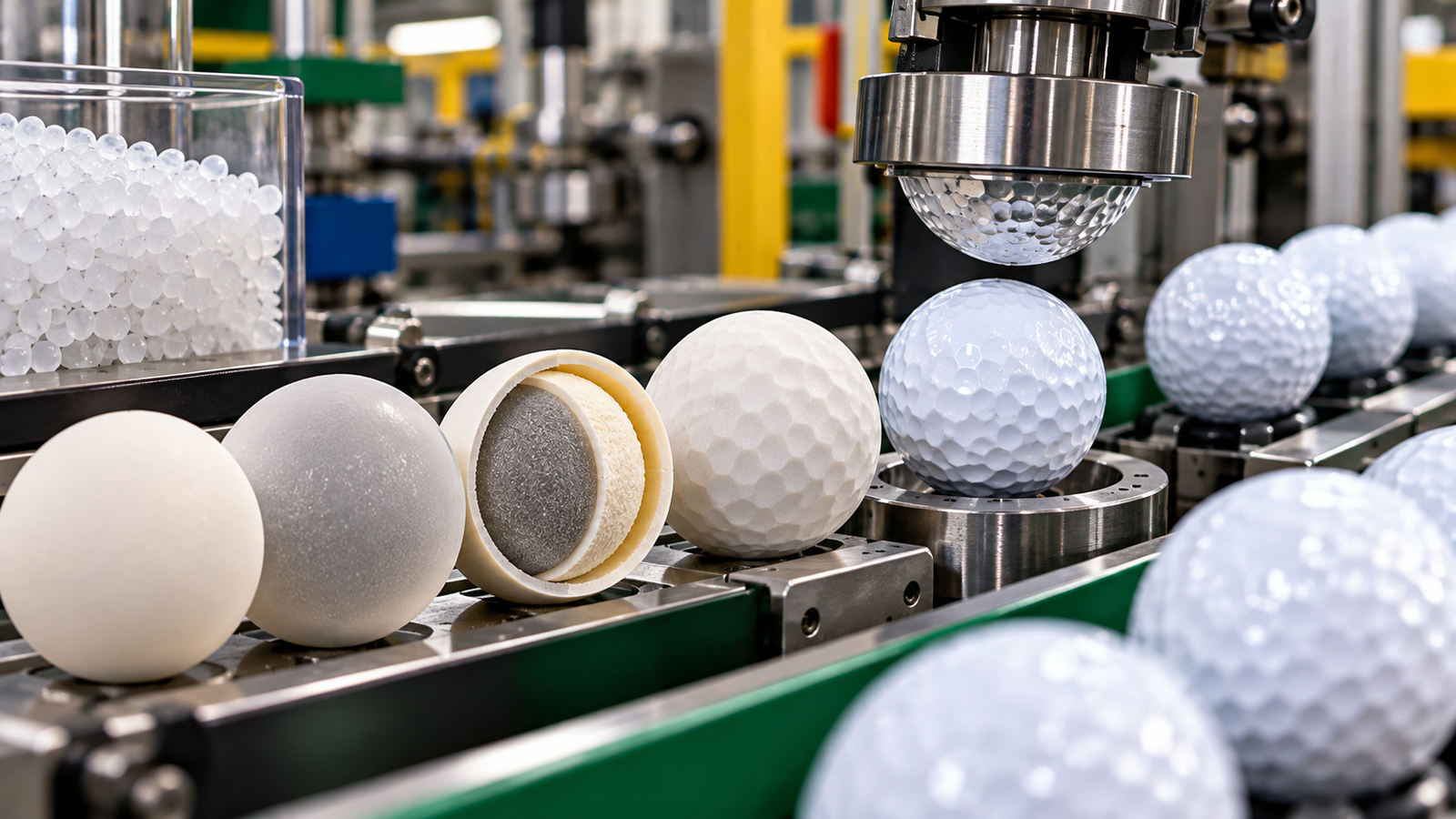
Golf balls are made by molding a rubber core, wrapping that core in one or more layers, adding a tough outer cover, and stamping in the dimples, then painting and testing every ball before it ships. That small white ball in your bag is one of the most engineered objects in sport. Here is how it goes from raw rubber to something you can trust off the tee.
The whole process is a mix of chemistry, heat, pressure, and very tight tolerances. A modern ball can have anywhere from two to five layers, and each one has a job. Once you see what each part does, choosing the right ball for your game gets a lot easier.
What is a golf ball actually made of?
A modern golf ball is built from rubber and plastic, arranged in layers. At the center sits a rubber core. Around it may be one or more thin layers called mantles. On the outside is a hard plastic cover, either Surlyn or urethane. The number of layers is what people mean when they say a ball is “two-piece” or “three-piece.”
The simplest balls have just two parts: a solid rubber core and a cover. The most advanced have five. More layers usually means more ways to fine-tune how the ball flies and spins, but also a higher price. Every layer changes how the ball feels and behaves, which is why two balls that look identical can play very differently.
The core: where distance starts
The core is the engine of the ball. It is made mostly from a synthetic rubber called polybutadiene, mixed with other chemicals that help it cure and spring back. Makers blend this rubber with activators, curing agents, and peroxide compounds, then press the mix under heat into a firm, solid ball.
The core’s job is to turn the energy of your swing into speed. A firmer core sends the ball faster and further, which suits players with a fast swing. A softer core feels gentler and helps slower swingers still get good distance. This is where a ball’s compression comes from, the number you often see on the box. Low compression feels soft, high compression feels firm.
Rule of thumb: a slower swing usually gets more out of a softer, lower-compression core, while a faster swing can handle a firmer one for extra distance.
Mantle layers: the performance tuner
Between the core and the cover, many balls have one or more mantle layers, sometimes called casing layers. These are thin shells of rubber or plastic wrapped around the core. You only find them in three-piece and higher balls.
The mantle is where a lot of the clever tuning happens. It manages spin. On a hard shot with a driver, a good mantle keeps spin low so the ball flies far and straight. On a soft shot near the green, it lets the ball grip and stop. Adding more mantle layers gives the maker finer control over this balance, which is why tour-level balls tend to have three, four, or even five pieces.
The cover: Surlyn vs urethane
The cover is the outer shell you actually touch. It decides how durable the ball is, how it feels, and how much it spins on short shots. Two materials dominate, and the choice between them is one of the biggest differences between a cheap ball and a premium one.
Surlyn is a tough ionomer resin. It resists cuts and scuffs, lasts a long time, and keeps its shape after years of abuse from a club face. Balls with a Surlyn cover feel firmer and spin less, which helps distance and forgiveness. They cost less, so they are popular with casual players and beginners.
Urethane is softer. It is the cover of choice on premium balls because it grips the grooves of a wedge and creates more spin around the green, giving skilled players real control over where the ball lands and stops. The trade-off is that urethane wears faster and costs more. If you want to see the difference in a maker’s own words, Titleist explains its cover technology on the official Pro V1 page.
How a golf ball is made, step by step
The factory process follows a clear order. Here is what happens on a typical production line for a multi-layer ball.
- Mix the rubber. Raw polybutadiene is blended with curing chemicals in a large industrial mixer until it forms a stiff, dough-like compound.
- Form the core. The compound is cut into small slugs and pressed in a mold under heat and pressure. This cures the rubber into a solid, springy sphere. The core is then ground to an exact size.
- Add the mantle. For three-piece and higher balls, one or more mantle layers are molded around the core, again under heat and pressure.
- Mold the cover and dimples. The core-and-mantle unit is placed in a mold whose inner surface is covered in tiny raised bumps. Hot cover material is injected or pressed around it. As the cover forms, those bumps stamp the dimples into the surface in one step. Small pins hold the ball centered while the cover sets.
- Trim and smooth. Any excess material, called flash, is trimmed away where the mold halves met, and the surface is cleaned up.
- Paint and stamp. The ball is painted white (or another color), the brand name and number are printed on, and a clear coat is added for shine and protection.
- Test and inspect. Balls are checked for weight, size, roundness, and flight. Many makers inspect every single ball, and top brands hold each mold cavity to strict limits so every dimple lands where it should.
The whole run has to hit very tight numbers. A ball that is a fraction too heavy, too big, or slightly out of round will not fly true, so quality control is a real part of the process, not an afterthought.
Why the dimples matter
Dimples are not decoration. A smooth ball would drop out of the air quickly, but the dimples change how air flows around the ball, cutting drag and adding lift. That is what lets a well-struck drive carry a couple of hundred yards instead of dying at your feet.
Most balls have somewhere between 300 and 400 dimples, with 336 and 392 being classic counts. There is no rule that sets an exact number. The count, size, shape, and pattern are all part of each maker’s design, tuned to give the flight they want. Common patterns arrange the dimples in repeating shapes so the ball is symmetrical and flies the same no matter how it sits on the tee.
Two-piece vs multi-piece: which build is which
The number of layers is the quickest way to understand a ball. Here is how the main builds compare.
| Feature | Two-piece ball | Three to five-piece ball |
| Layers | Core plus cover | Core, one or more mantles, cover |
| Core | Large, firm rubber | Softer, tuned rubber |
| Cover | Usually Surlyn (ionomer) | Usually urethane |
| Feel and spin | Firmer, lower spin | Softer, more greenside spin |
| Best for | Distance, durability, value | Control, feel, better players |
| Durability | Very high | Good, wears faster |
Two-piece balls are the workhorse of the game. They are built for distance and durability, and they make up the bulk of balls sold. Multi-piece balls trade some of that toughness for the spin control and soft feel that better players want on approach and short shots.
The rules every ball has to meet
Golf balls are not a free-for-all. To be legal for tournament play, a ball has to meet standards set by the sport’s governing bodies, the USGA and the R&A. These rules keep the game fair and stop makers from building a ball that flies unreasonably far.
- Weight: no more than 1.62 ounces (45.93 grams).
- Size: at least 1.68 inches (42.67 mm) across.
- Symmetry: the ball must fly the same regardless of how it is placed, so no directional designs.
- Speed and distance: the ball cannot leave the club faster than a set limit, and it must stay under an overall distance standard in testing.
Because a heavier, smaller ball tends to fly further, almost every maker builds right up to the limits: the maximum weight and as close to the minimum size as their production allows. You can read the exact wording on the USGA’s equipment rules page. For casual rounds none of this changes much, but it is why a conforming ball from any brand sits within the same narrow window.
Conclusion
Golf balls are made by molding a rubber core, wrapping it in mantle and cover layers, stamping in the dimples, then painting and testing each one to tight limits. The core drives distance, the mantle tunes spin, the cover sets feel and control, and the dimples keep it in the air. Knowing what each part does is enough to pick a ball that fits your swing: softer and multi-layer for control, firmer two-piece for distance and value.
Frequently asked questions
What are golf balls made of?
They are made of rubber and plastic in layers. A rubber core sits at the center, with thin mantle layers in better balls, and a hard plastic cover of Surlyn or urethane on the outside.
How many dimples does a golf ball have?
Most have between 300 and 400, often 336 or 392. There is no set number. Each maker chooses the count and pattern to get the flight they want, as long as the ball stays symmetrical.
Why do golf balls have dimples?
Dimples change how air moves around the ball, cutting drag and adding lift. That is what lets a ball carry far through the air. A smooth ball would slow down and drop much sooner.
What is the difference between Surlyn and urethane covers?
Surlyn is harder, cheaper, and very durable, with lower spin. Urethane is softer, spins more around the green for better control, but wears faster and costs more. Premium balls use urethane.
How much does a golf ball weigh?
A conforming golf ball weighs no more than 1.62 ounces (45.93 grams) and is at least 1.68 inches wide. Most makers build right up to these limits for the best distance.
[…] How Are Golf Balls Made? Inside the Real Process […]
[…] How Are Golf Balls Made? Inside the Real Process […]
[…] How Are Golf Balls Made? Inside the Real Process […]