
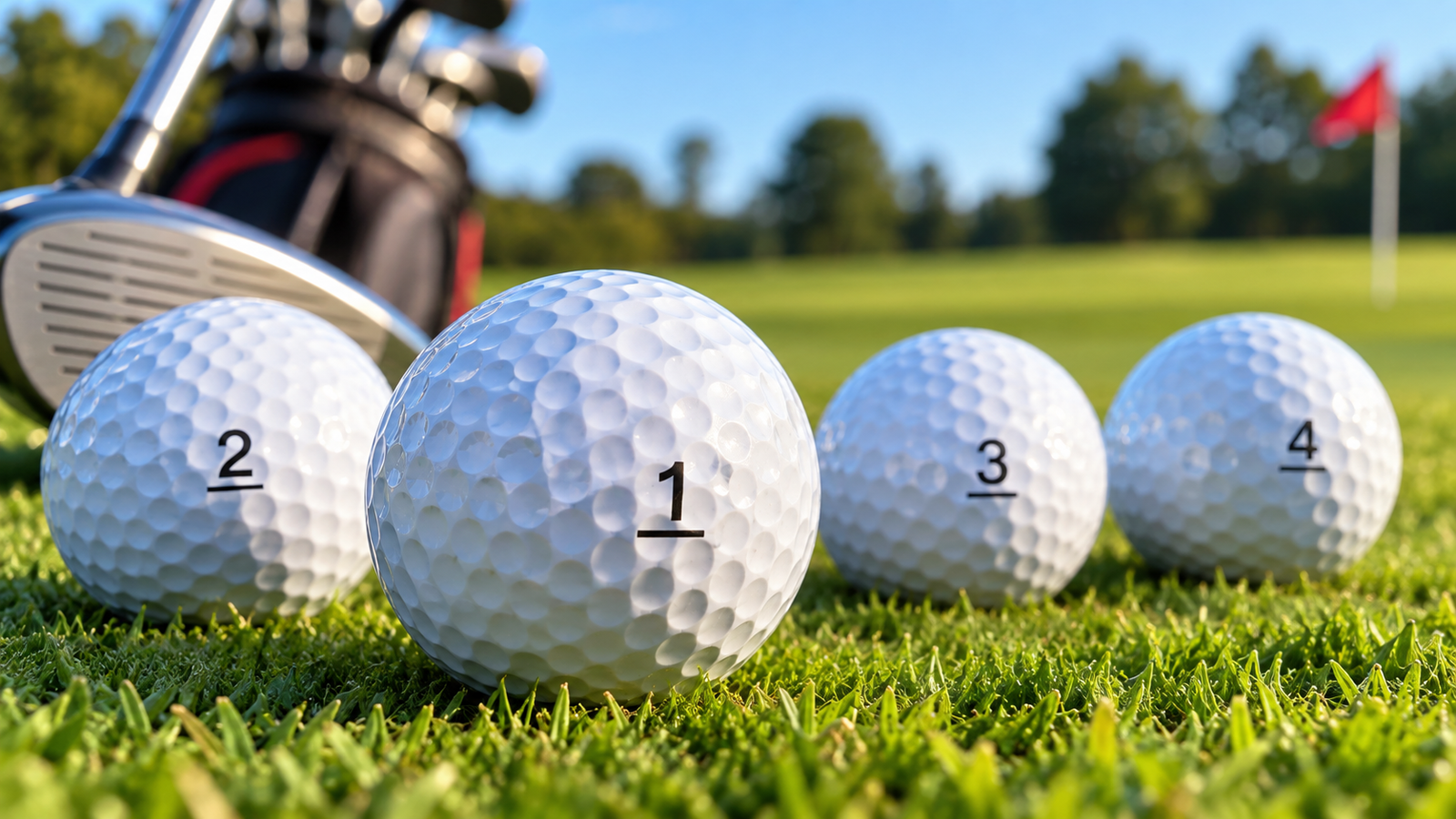
Pick up almost any golf ball and you will see a number printed under the brand name, and sometimes a few more numbers around the ball. Here is the short answer: the meaning depends on how many digits the number has. A single digit is just there to help you tell your ball apart from everyone else’s. A two-digit number is usually the compression rating, which is about how soft or firm the ball feels. A three-digit number is the dimple count, the number of tiny dents on the cover.
That covers it in one breath. Now let’s look at each type so you know exactly what your ball is telling you, and which numbers actually change how you play.
Single-digit numbers: your ball’s ID
The most common number on a golf ball is a single digit, usually 1, 2, 3, or 4. This number has no effect on how the ball flies, spins, or feels. It is only there so you can identify your ball on the course.
Think about a normal round. You and a friend both play the same brand and model, say a Titleist or a Callaway. If you both hit into the same area, how do you know which ball is yours? The number solves that. You play the 2, your friend plays the 4, and there is no confusion.
There is a simple reason most balls carry a 1 through 4. A dozen balls comes packed as four sleeves of three, and each sleeve is stamped with the same number. So one sleeve is all 1s, the next all 2s, and so on. That is really all there is to it.
You can find single digits up to 9, and many brands now let you order custom numbers from 0 to 99. Some golfers pick a lucky number, a birthday, or the score they are chasing. It is a nice personal touch, but it still does nothing to the ball’s performance.
The number also helps in one situation new golfers often miss: the provisional ball. If you think your first shot might be lost, the rules let you play a second ball while you go look. Playing a different number for that provisional shot means you can instantly tell which ball is which if you find both, so you know which one counts.
The number even helps under the rules. The USGA’s rule on identifying your ball lets you confirm a ball by its brand, model, and number, so playing a number nobody else in your group is using can save you trouble if two balls end up close together.
Tip: Even with a printed number, add your own mark. A couple of dots or your initials with a permanent marker means that even if two players carry the same numbered ball, you can always prove which one is yours.
Two-digit numbers: compression
If you see a two-digit number, like 70, 80, 90, or 100, it usually points to the ball’s compression rating. Compression is a measure of how much the ball squashes when your club strikes it. A lower number means a softer ball that squashes more. A higher number means a firmer ball that barely gives.
Compression ratings run from around 30 at the soft end to about 120 at the firm end. In the past this number was printed right on the ball and used heavily in marketing. Most balls sold today no longer show it on the cover, so if you find a ball with a small 80 or 90 stamped on the side, it is probably a couple of decades old. You can still look up the compression of any modern ball on the maker’s product page.
Compression is the one number here that can genuinely affect your game, because it is tied to your swing speed.
What compression means for your swing
The rough idea is to match the ball’s firmness to how fast you swing. A slower swing does not generate enough force to compress a firm ball properly, so a softer ball helps you get more out of each hit. A faster swing can compress a firm ball fully, which gives better control.
It helps to picture what compression actually does at impact. When the club face hits the ball, the ball flattens for a split second and then springs back to shape, and that spring is part of what launches it forward. A softer ball flattens more easily, so a gentle swing can still make it spring. A firm ball needs a harder hit to flatten the same way. Send too little force into a firm ball and it leaves energy on the table; that is why a slow swinger often loses distance with a firm ball and gains it with a soft one.
Compression also has a small effect on spin and feel. Softer balls tend to feel cushioned and produce a touch less spin, which many players like for a forgiving, straight flight. Firmer balls feel more solid and can give skilled players a bit more spin and shot control. Neither is better on its own; the right choice depends on your swing and what you want the ball to do.
| Compression rating | Feel | Best for swing speed |
| Low (about 30 to 60) | Soft | Under 85 mph |
| Mid (about 70 to 90) | Medium | About 85 to 100 mph |
| High (about 90 to 120) | Firm | Over 100 mph |
Treat these numbers as a starting point, not a strict rule. Feel matters too. Many golfers with average swing speeds simply prefer the soft feel of a lower-compression ball around the greens, and that is a perfectly good reason to choose one. If you want to be sure, a proper ball fitting, which many good golf shops offer, will match a ball to your actual swing.
Three-digit numbers: the dimple count
A three-digit number, something like 332, 352, or 392, is the number of dimples on the ball. Those are the small cup-shaped dents covering the surface. Most balls have somewhere between 300 and 500 of them.
Dimples are not decoration. A smooth ball would drop out of the air quickly, but the dimples cut down air resistance and help create lift, so the ball flies farther and straighter. The pattern, depth, and shape of the dimples all play a part, which is why two balls with a similar count can still fly quite differently.
Here is the honest part: the printed dimple number is mostly trivia. Knowing that a ball has 352 dimples instead of 332 tells you almost nothing about how it will play, because performance comes from the whole design working together. Manufacturers used to print the count more often, and you will still see it on some older balls, but most modern balls leave it off.
So enjoy the dimple count as a bit of design trivia, and judge a ball by how it flies and feels rather than by that number.
Red numbers vs black numbers
You may notice that the number is sometimes red and sometimes black. Long ago the color was a quick signal for compression, with red for softer balls around 90 compression and black for firmer balls around 100. That meaning has faded, and on a modern ball the color no longer reliably tells you the compression.
Today the color is used in two main ways. Some brands use it to separate models in the same family. Titleist is the well-known example: a black number means you are holding a Pro V1, while a red number means a Pro V1x. Other times the color is simply a design choice with no meaning at all. So if you are trying to read a ball, check the model name first and treat the color as a hint, not a rule.
How to pick and mark the right ball
Now that you can read the numbers, choosing a ball gets simpler. Ignore the single digit, since it changes nothing. Focus on compression relative to your swing speed if you want more distance, and pick the feel you enjoy on and around the greens. The dimple count you can safely ignore.
A few practical habits make a difference:
- Play one model consistently for a while so you learn how it behaves, instead of switching every round.
- Pick a single-digit number that others in your group are not using.
- Add a personal mark with a marker, even on a numbered ball, so identification is never in doubt.
- If you are unsure about compression, start softer if your swing is smooth and slower, firmer if you swing hard and fast.
Do all of that and the numbers stop being a mystery. They become a small, useful part of choosing and keeping track of the ball that suits you.
Conclusion
The numbers on a golf ball are easy to read once you know the pattern. A single digit is only an identifier, so pick one your group is not using and add a personal mark. A two-digit number is compression: soft for slower swings, firm for faster ones, and the one figure worth matching to your game.
A three-digit number is the dimple count, interesting but not something to choose a ball by. Read those three and you will pick the right ball with confidence.
Frequently asked questions
Does the single-digit number on a golf ball affect performance?
No. A single digit, usually 1 to 4, is only for identification so you can tell your ball from a playing partner’s. It has no effect on distance, spin, or feel. Choose any number you like.
What is a good compression for a slower swing speed?
If you swing under about 85 mph, a low-compression ball of roughly 30 to 60 usually helps. It squashes more easily, which can add distance and gives a softer feel. Faster swings suit firmer balls.
What do the three-digit numbers on golf balls mean?
They show the number of dimples on the ball, usually between 300 and 500. Dimples help the ball fly farther and straighter, but the count alone does not tell you how well a ball performs.
Do red and black numbers mean different compressions?
Not anymore. The color once hinted at compression, but today it usually separates models in a range, such as Titleist Pro V1 in black and Pro V1x in red, or it is just a design choice.
Can I put a custom number on my golf ball?
Yes. Many manufacturers let you order balls with a custom number, often anywhere from 0 to 99. Golfers pick lucky numbers, birthdays, or a target score. It is personal only and does not change how the ball plays.
Related Articles
How Are Golf Balls Made? Inside the Real Process
How to Wash Golf Hats Without Ruining Them?
How to Throw an Anhyzer Shot in Disc Golf?
Are Nitro Golf Balls Any Good? An Honest Look at the Budget Brand
[…] What Do the Numbers on Golf Balls Mean? […]
[…] What Do the Numbers on Golf Balls Mean? […]