
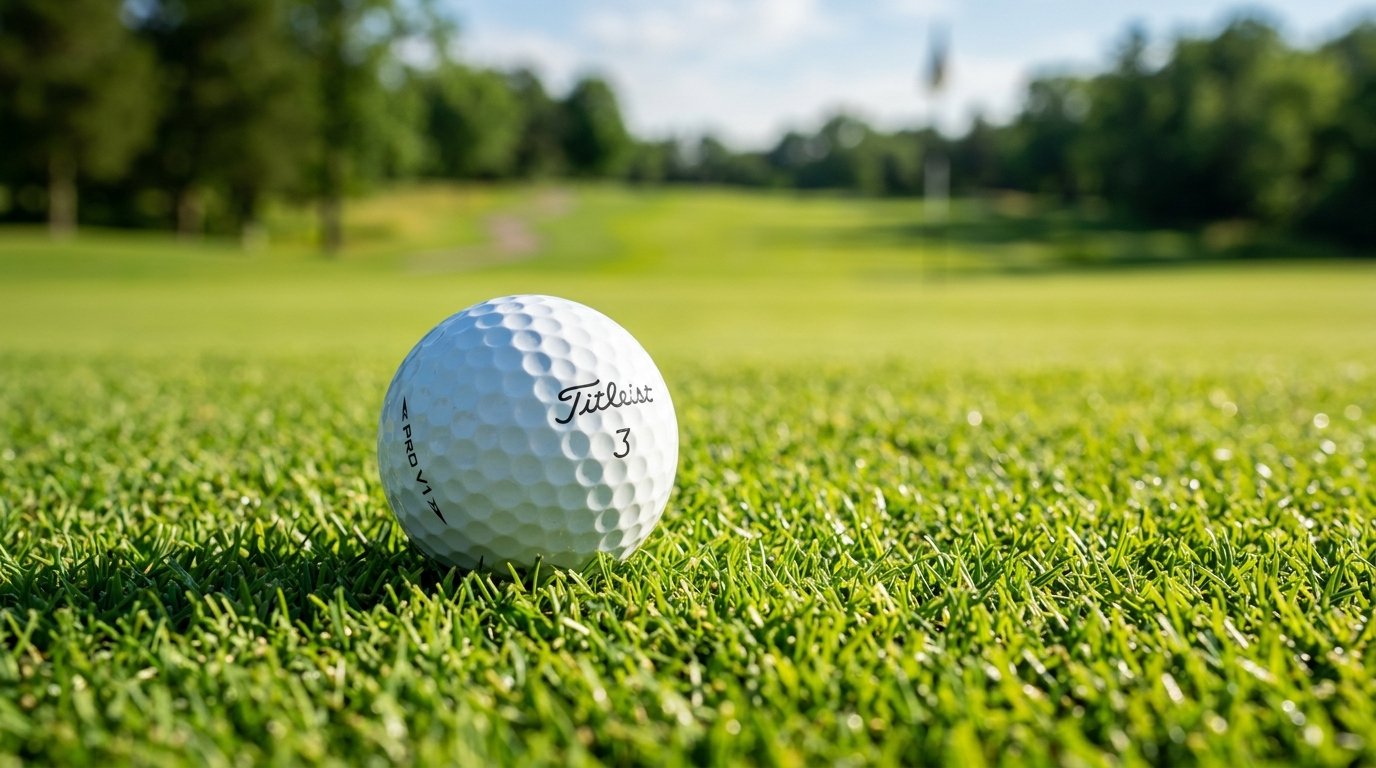
A golf ball can weigh no more than 45.93 grams, or 1.62 ounces. That number comes straight from the Rules of Golf, jointly written by the USGA and The R&A, and it is a ceiling, not a target. There is no minimum weight, but almost every ball sold today is built to sit right at that maximum, because a heavier ball, up to the legal limit, carries more momentum through the air.
Here is what that number means in practice, how it compares with other balls you already know the feel of, and why weight matters less to your game than you might think.
What is the official weight limit for a golf ball?
The Rules of Golf cap a conforming golf ball at 1.620 ounces avoirdupois, which converts to 45.93 grams. This limit sits in Appendix III of the Equipment Rules that the USGA and The R&A maintain together, alongside the minimum diameter of 1.680 inches and a handful of other tests every ball has to pass before it lands on the official list of conforming golf balls.
Manufacturers submit two dozen samples of each model every year so the rule makers can weigh and measure them on approved equipment. A single ball that comes in over 45.93 grams fails on the spot, no matter how well it performs everywhere else, and if four or more balls in a sample batch exceed the mass limit or fail the size test, the whole model gets ruled non-conforming and comes off the approved list. You can read the full weight and size specification on the USGA equipment rules page and the equivalent rules maintained by The R&A.
The weight rule has barely moved in a century. Golf’s governing bodies set a version of this same 1.62 ounce cap back in the 1920s, long before dimple patterns, urethane covers, or multi-layer cores existed. Everything about ball design has changed since then except this one number.
Why is there a maximum but no minimum weight?
A heavier object holds onto its speed better once it is moving, because momentum depends on mass. A golf ball near the legal weight limit resists wind and air drag more effectively than a lighter one, so it tends to fly straighter and carry farther for the same swing. Cap that weight and you limit how much raw mass can add to distance, which is exactly what the rule is there to do.
A minimum weight was never needed for a simple reason: going lighter has no upside. A very light ball loses speed fast once it leaves the clubface, spins in ways that are harder to control, and gets pushed around by wind. Drop a golf ball’s mass and you get something closer to a whiffle ball: easy to launch, hard to keep on line once a breeze picks up. Manufacturers have no reason to build a golf ball anywhere below the ceiling, so the market settled the question on its own, without a rule forcing it.
Does every golf ball weigh exactly 45.93 grams?
No single number is the same across every model, though most land close together. Premium tour balls typically weigh between 45.6 and 45.93 grams, with many brands building right up against the legal ceiling because that extra fraction of a gram, within the limit, still helps with carry and stability in the air. A two-piece distance ball and a five-layer tour ball can differ by a few tenths of a gram even though both are legal.
What actually varies more than the number on a scale is what makes up that weight. A tour ball packs a dense core, several thin mantle layers, and a soft urethane cover into that same mass. A cheaper two-piece ball reaches a similar weight with a simpler core and a harder ionomer cover. Two balls can weigh almost the same and still feel completely different off the clubface.
How much does a dozen golf balls weigh?
A dozen new golf balls, each at the legal maximum, weigh about 551 grams total, which works out to roughly 1.215 pounds or 19.44 ounces. That figure is handy if you are estimating shipping weight for an order or just curious what a full box feels like in your hand. A sleeve of three balls comes in at about 138 grams, light enough that a full dozen still fits easily in a cart bag pocket.
How does a golf ball’s weight compare with other balls?
Golf balls sit in an odd spot: close in size to a ping pong ball but nowhere near it in weight, and noticeably smaller and lighter than a baseball or tennis ball.
| Ball | Typical weight |
| Table tennis ball | about 2.7 grams |
| Golf ball | up to 45.93 grams |
| Tennis ball | about 56 to 59 grams |
| Baseball | about 142 to 149 grams |
| Bocce ball | about 920 grams |
A golf ball and a ping pong ball are almost the same diameter, yet the golf ball weighs roughly seventeen times more. That gap comes down to density. A ping pong ball is a hollow shell of thin plastic, while a golf ball packs a solid rubber or resin core and several dense layers into the same small sphere, which is why one bounces off a paddle and the other can be driven more than 250 yards.
Does a heavier golf ball go farther?
Within the legal range, yes, added mass helps a ball hold its speed and resist drag once it is in flight. But weight is only one piece of the distance equation, and it is not the piece that separates a good ball from a mediocre one, since virtually every ball on the market already sits close to the 45.93 gram ceiling.
Your actual distance comes far more from clubhead speed, angle of attack, and how well a ball’s compression matches your swing. A golfer with a slower swing speed often gets more distance from a lower compression ball that deforms easily at impact, even though it weighs about the same as a high compression tour ball built for faster swings. Picking a ball by compression and construction, rather than chasing weight, is what actually changes how far it goes for you personally.
Does weight affect feel and spin?
Feel and spin come mostly from construction, not the number on a scale. A soft urethane cover grips the clubface longer at impact and produces more spin around the green, while a firmer ionomer cover produces less spin and a firmer feel, regardless of whether the two balls weigh 45.7 or 45.9 grams. Dimple pattern and core compression shape ball flight and stopping power far more than the small weight differences allowed under the rule.
Think of weight as a fixed constraint that every legal ball already satisfies, and the real shopping decision as everything layered inside that same fixed mass: how many layers, what core material, and what cover the engineers chose to reach 45.93 grams.
What happens if a ball’s weight is off?
A dry, undamaged ball straight from the sleeve will weigh what its label promises, at or under the legal cap. Problems start once a ball is damaged or waterlogged. A cracked cover or a core that has absorbed water through hairline damage can push a used ball’s weight above the legal limit, and that extra water weight does not help it. It throws off the ball’s balance, dampens its bounce, and shortens flight instead of adding to it. A ball fished out of a pond after weeks underwater is heavier than 45.93 grams and will not perform like, or qualify as, a conforming ball.
That is also why range balls and old practice balls often feel dead compared to a new one. Repeated impacts compress the core over time, and any moisture that gets in adds weight in exactly the wrong place. If you fish a ball out of a hazard and it feels the slightest bit heavy or sounds dull off the clubface, treat it as a range ball rather than one to put back in play for anything serious.
Conclusion
A golf ball tops out at 45.93 grams, or 1.62 ounces, under the Rules of Golf, and there is no floor beneath it. Nearly every ball sold today is built close to that ceiling because extra mass, up to the limit, helps it hold speed and resist wind. A dozen new balls weigh about 551 grams together. What actually separates one ball from another, though, is not the number on the scale. It is the core, layers, and cover packed into that same fixed weight, so choose a ball by compression and feel, not by chasing grams.
Frequently asked questions
What is a golf ball’s weight in ounces?
A golf ball can weigh up to 1.62 ounces, or 45.93 grams, under the joint USGA and R&A rules. Nearly every ball on the market today is built right at that legal maximum.
Are all golf balls the same weight?
Not exactly. Weights typically range from about 45.6 to 45.93 grams depending on the model, since the rule sets a ceiling rather than one fixed number every ball must hit.
How much does a used golf ball weigh?
A dry, undamaged used ball still weighs close to 45.9 grams. A cracked or waterlogged ball can weigh more than the legal limit, since absorbed water adds mass without adding performance.
Does a heavier golf ball travel farther?
Up to the legal limit, more mass helps a ball resist drag and hold its speed. Past that point, your swing speed and the ball’s compression matter far more than its exact weight.
How much does a dozen golf balls weigh?
A dozen new golf balls weigh about 551 grams combined, which is close to 1.215 pounds or 19.44 ounces, based on the 45.93 gram legal maximum per ball.
Related Articles
How to Wash Golf Gloves Without Wrecking Them?
How to Measure Golf Shaft Length (Step-by-Step Guide)
What Hand Do You Wear a Golf Glove On? (Left vs Right)
How Many Clubs Are in a Golf Bag? (14-Club Rule)