
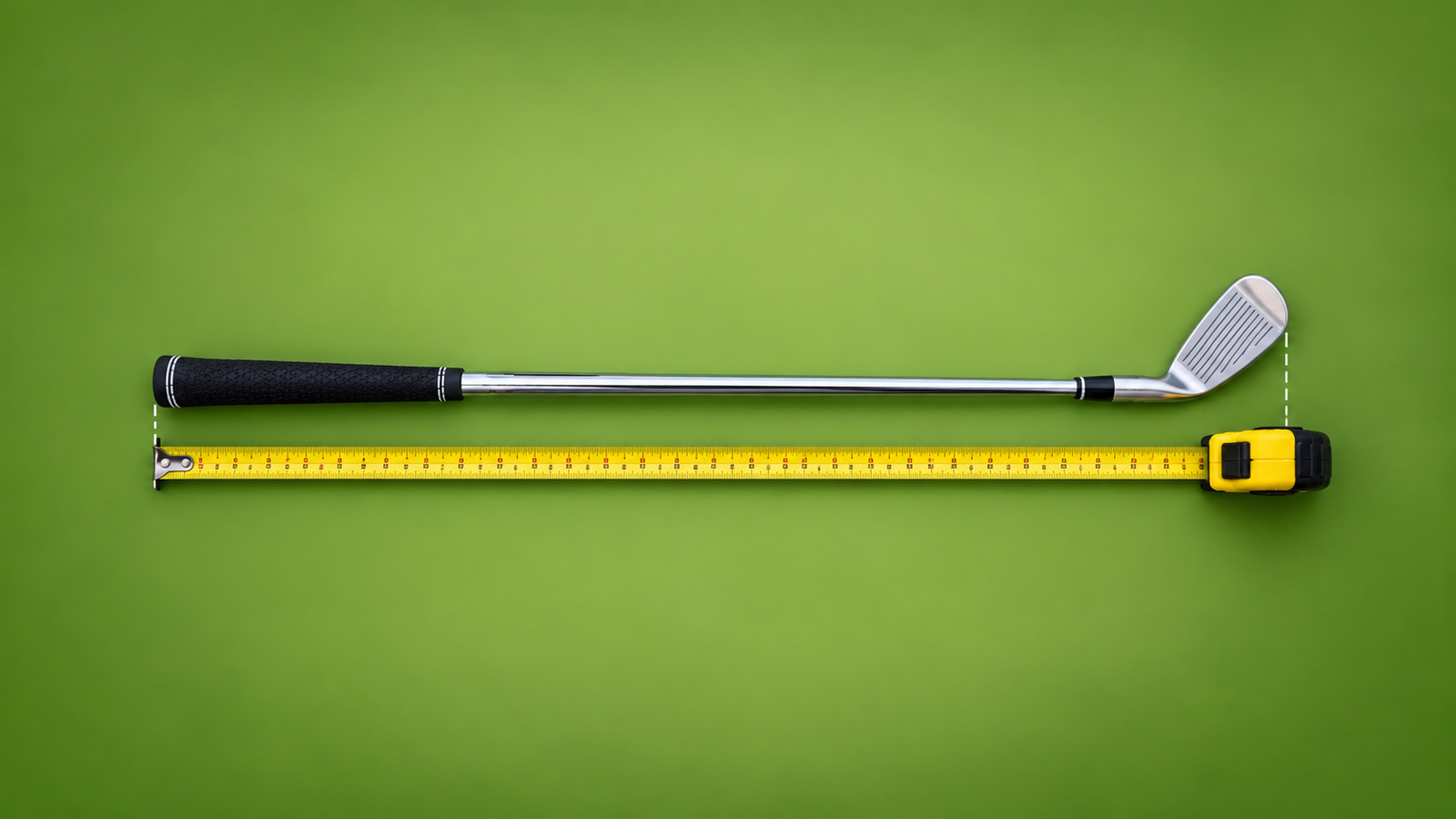
To measure golf shaft length, rest the club on a hard floor in its playing position, stand a rigid 48-inch ruler behind the heel with one corner touching the ground, and read the number where the ruler meets the end of the grip. That figure, in inches, is the length of the club. One tool, about a minute per club.
Two things change the answer. On a finished club, length is measured from the ground up, so the head is part of the reading. A bare shaft that has not been glued into a head yet is measured tip to butt instead, and gives a very different number. Both are covered below.
What you need before you start?
A rigid 48-inch ruler is the only piece of kit that really matters. Aluminium rulers sold for club building have a squared corner or a small soleplate that sits flat on the floor, and that corner is what makes the reading repeatable. A tape measure sags and lifts away from the shaft. A yardstick stops at 36 inches, which is shorter than every club in the bag except a wedge or a putter.
You also want a hard, flat floor. Carpet lets the sole press in, and every fraction the head sinks comes off the reading. Tile, wood or concrete works.
Keep a pen nearby. Measure each club twice and write both numbers down, because a single reading tells you nothing about whether your technique was steady.
How to measure an assembled club, step by step?
- Sole the club. Set the head on the floor the way it sits at address, with the centre of the sole flat and both heel and toe touching. You are not taking your stance here. You are just squaring the head.
- Put the ruler corner on the floor behind the heel. It goes at the point where the line of the shaft would run into the ground, directly behind the heel of the club.
- Lean the ruler onto the shaft. Run it up the back of the shaft towards the grip. A round tube never sits perfectly flush against a flat edge, so aim for parallel and touching rather than perfect.
- Read the number at the grip. The usual shop reading is taken at the edge of the grip cap, where the flat of the cap starts to curve over.
- Do it again. Lift the club, reset it, and take a second reading. Two numbers within an eighth of an inch means your technique held up. If they are further apart than that, the head moved.
Pick one ruler, one grip reference and one way of soling the head, then use that same combination every time. Length is only useful as a comparison, either against a spec sheet or against the club next to it in the bag, and a comparison falls apart the moment the method changes.
What throws the reading off?
Four things account for almost every bad measurement.
Standing the club upright against a wall is the biggest one. The head ends up resting on its toe, the shaft sits at an angle it never reaches at address, and the ruler follows the wall instead of the shaft. What you get is the height of a club balanced on its toe, not its length.
Letting the heel or the toe lift off the floor is the next. Tipping the head rolls the shaft towards or away from the ruler and moves the point where the shaft line meets the ground, so the same club can read several fractions apart from one attempt to the next.
Soft ground does quiet damage. Carpet, a rubber mat or grass all let the sole settle in, and the reading shrinks.
Switching the grip reference partway through a set is the sneakiest. Measure three irons to the cap edge and two to the top of the cap and the gaps between your clubs look wrong when the clubs themselves are fine.
How the rules define club length?
The governing bodies use a fixture rather than a floor. Under the USGA’s equipment rules, a wood or iron is measured lying on a horizontal plane with the sole set against a 60-degree plane, and the length runs from the point where those two planes meet up to the top of the grip. Putters are measured from the top of the grip along the axis of the shaft, or a straight-line extension of it, down to the sole. Overall length must be at least 18 inches, and for everything except a putter it cannot exceed 48 inches.
Two details make that reading differ slightly from the one you take on your kitchen floor. The 60-degree plane holds every head at the same angle no matter what its own lie angle is, and the measurement runs to the very top of the grip cap rather than to its edge. Together they are worth roughly an eighth of an inch, which is why a club can measure fractionally longer under the rules than on a bench.
Elite play has a tighter ceiling. Since 1 January 2022, professional and elite amateur competitions can adopt a local rule capping clubs other than putters at 46 inches, with a measurement tolerance of 0.20 inches above that. Everyday club golf still runs to the full 48.
Measuring a putter is different
A putter shaft meets the head at a much steeper angle, so running a ruler up from the floor behind the heel reads short. Measure along the shaft instead.
For a centre-shafted putter, the shaft runs straight into the head, so lay the ruler along the shaft line and measure from the sole to the top of the grip. For a heel-shafted or offset putter, follow the line of the shaft as though it carried straight on through the head to the sole, and take your measurement along that extended line.
Measuring a raw shaft that is not in a head
Lay the shaft flat and measure along it from the tip, the narrow end that goes into the head, to the butt, the wide end that takes the grip. That is raw length, and it is the figure printed on a shaft spec sheet.
Raw length is not playing length, and the gap is bigger than most people expect. Driver shafts usually arrive at about 46 inches uncut, with long-drive versions running to 50. Shafts built for fairway woods sit near 44 inches, hybrid shafts land between 42 and 44, and parallel-tip steel iron shafts come in around 41 to 42 inches.
A 46-inch raw driver shaft does not build a 46-inch driver. Part of the tip disappears into the hosel or the adapter, and the butt then gets cut down to the finished playing length. Iron shafts go through more. A parallel-tip shaft is tip trimmed first, following the manufacturer’s trim chart, because that trim is what sets the flex. Take three inches off the tip of a 41-inch shaft for a 7-iron and you are down to 38 inches before the butt cut even happens.
So if you are buying shafts to build or rebuild a club, the raw number tells you what you have to work with. The finished club length is the number you measure afterwards, from the floor.
What your number should look like?
| Club | Typical men’s standard length |
| Driver | 45 to 45.75 inches |
| 5-iron | 38 inches |
| 7-iron | 37 inches |
| 9-iron | 36 inches |
| Pitching wedge | 35.5 to 35.75 inches |
| Putter | 33 to 35 inches |
Irons step down half an inch per club, and that pattern is remarkably consistent across brands. Titleist’s T-Series spec table runs a T150 set from 39 inches at the 3-iron to 35.5 at the gap wedge, with the 7-iron at 37. Ping’s i230 line lands on the same numbers club for club. Women’s standard sets are usually about an inch shorter throughout.
Fairway woods and hybrids fill the gap between the driver and the long irons, and they vary more between models than irons do, so check the spec sheet for the exact head rather than assuming.
Why an eighth of an inch is worth chasing?
Length is not just a comfort setting. Change a club’s length by half an inch and swingweight moves by roughly three points, so the head feels noticeably lighter or heavier through the swing. The same half inch shifts effective lie angle by about half a degree to a degree, which moves the face angle at impact and pushes strikes towards the heel or toe.
That is the practical reason to measure carefully. A club sitting half an inch off its spec sheet is not the same club as the one described on the sheet, even with an identical head and shaft. It is also the reason to measure a used club before you buy it, and to measure a club again after any re-shaft, extension or cut down.
Conclusion
Sole the club on a hard floor, set a rigid 48-inch ruler on the ground behind the heel, run it up the back of the shaft, and read at the grip cap. Raw shafts get measured tip to butt instead, and that number is always longer than the club it will become. Two readings within an eighth of an inch means you did it right, and that is accurate enough to check any club against a spec sheet.
Frequently asked questions
Can I measure golf shaft length with a tape measure?
You can get close, but not close enough to trust. A tape sags and pulls away from the shaft, which usually costs you a quarter of an inch or more. A rigid 48-inch ruler is the only tool that gives repeatable numbers.
Do I measure to the top of the grip or the edge of the grip cap?
Most shops and fitters read at the edge of the cap. The rules of golf read to the very top. The difference is about an eighth of an inch, so pick one and use it consistently.
Does golf shaft length include the club head?
On a finished club, yes. The measurement starts at the ground behind the heel, so the height of the head is part of the reading. Only a bare, uninstalled shaft is measured purely tip to butt.
How long can a golf club be?
Up to 48 inches for everything except a putter, which has no upper limit, and at least 18 inches for any club. Professional and elite amateur events can apply a stricter 46-inch cap.
Does regripping change my club’s length?
Barely. A new grip of the same size sits in the same place on the shaft, so the reading stays within a fraction. Extensions, butt cuts and re-shafts are what actually move the number.
Related Articles
How to Wash Golf Gloves Without Wrecking Them?
What Hand Do You Wear a Golf Glove On? (Left vs Right)
How Much Does a Golf Ball Weigh?
How Many Clubs Are in a Golf Bag? (14-Club Rule)
[…] How to Measure Golf Shaft Length (Step-by-Step Guide) […]
[…] How to Measure Golf Shaft Length (Step-by-Step Guide) […]