
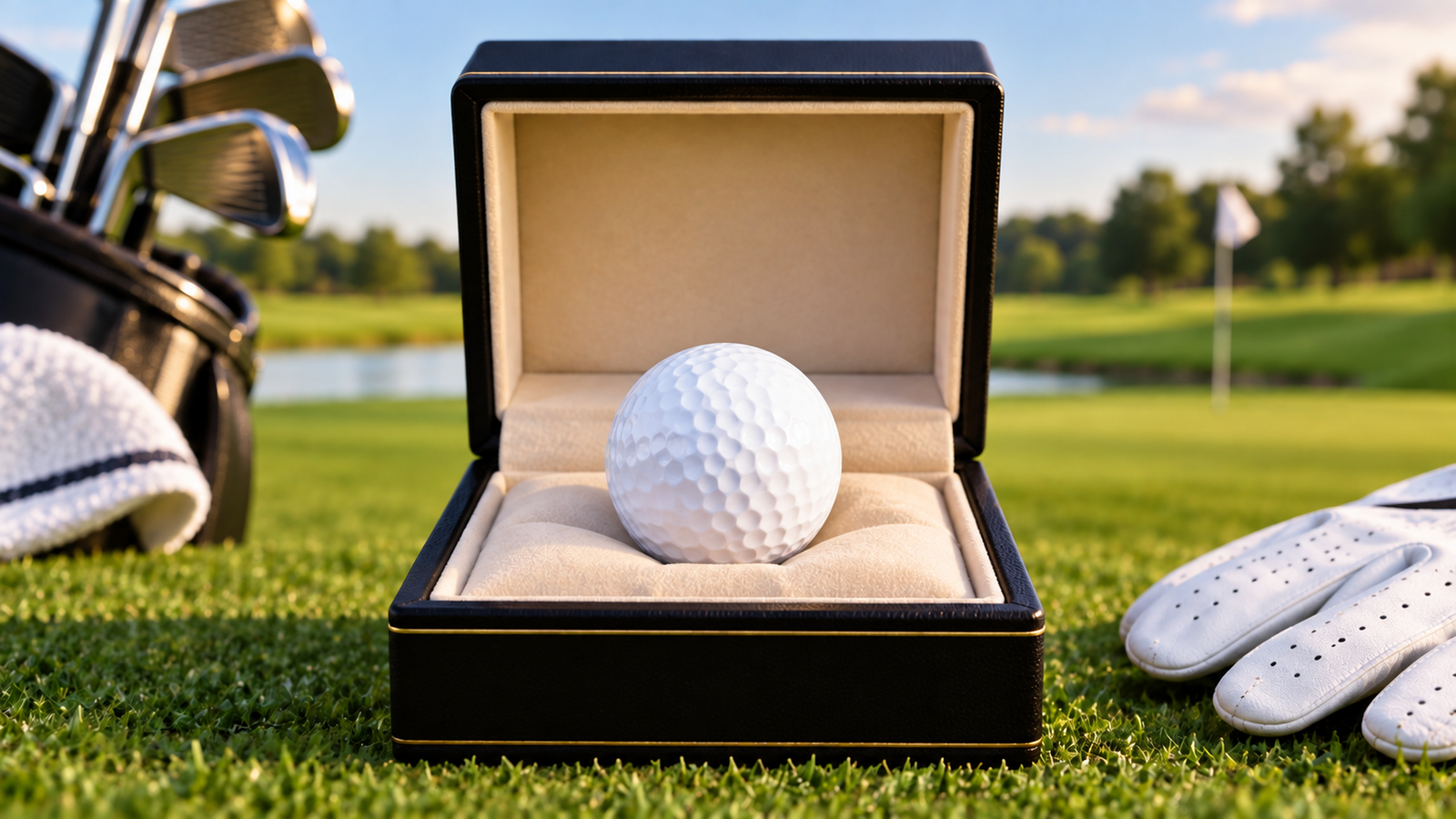
The most expensive golf ball you can buy brand new is the Attomax, priced at $249 a dozen, or a little over $20 for a single ball. But if the question means which golf ball has ever sold for the most money, the answer is a completely different ball: a 125-year-old gutta-percha sphere that Harry Vardon played to win the 1900 U.S. Open, sold at auction in June 2025 for $194,259.20.
Those two answers rarely show up together, because “most expensive golf ball” actually asks two separate questions: what does a premium new ball cost, and what has a piece of golf history sold for. Here is both, along with what makes each one worth its price and where it sits next to the balls most golfers actually play.
What is the most expensive golf ball you can buy new?
The Attomax holds that title at $249 per dozen, split into Soft, Medium, and Hard versions built around swing speed rather than feel; the firmer option is aimed at players swinging above 105 miles per hour. A half dozen runs $139. That works out to roughly $20.75 a ball, about four to five times what a dozen of golf’s most popular tour ball costs. Each ball measures about 42.7 millimeters across, close to the standard 42.67 millimeter minimum diameter used across the sport, and comes in white.
Attomax builds its ball around an amorphous metal alloy called Attometal, developed by Attometal Tech, a materials affiliate of the Korean manufacturer Kolon Industries. Unlike a normal crystalline metal, an amorphous metal has no fixed internal structure, so it stays springier under impact instead of deforming the way ordinary metal does.
Attomax packs a powder of this alloy into the ball’s mantle layer, the thin shell that sits between the core and the outer cover, to boost energy transfer off the clubface. In a test using a World Record Committee certified robotic swinger, Attomax balls flew 15 to 20 yards farther than 13 other ball models from 10 competing brands, and the World Record Committee recognized Attomax as the longest flying golf ball on record.
That distance comes with a tradeoff. Even at $249 a dozen, the Attomax uses an ionomer cover rather than the softer urethane cover found on nearly every premium tour ball, which usually means less spin and feel around the greens.
The ball also does not appear on the USGA and R&A’s list of conforming golf balls, so it cannot be used in a sanctioned tournament, a club competition, or any round where you are trying to post a handicap score. It is built for recreational distance, not competitive play, and it comes with a one year manufacturer warranty rather than any kind of performance guarantee.
How does it compare to premium tour balls?
Most golfers never spend anywhere near $249 on a dozen balls. Titleist’s own Pro V1 page lists the ball used by more tour professionals than any other at $55 a dozen. TaylorMade’s TP5 and TP5x run about $45 to $50, Callaway’s Chrome Soft sits in a similar $40 to $50 range, and Bridgestone’s Tour B series lands around $40 to $50 as well. All four use a urethane cover, a multi-layer core built for spin control, and appear on the conforming ball list, so they can be played in any competition, from a Saturday four-ball to a USGA event.
The gap between those balls and the Attomax is not really about performance tiers within the same category. A Pro V1 is priced for tournament-ready spin, feel, and durability, refined over more than two decades of tour use. The Attomax is priced for straight-line distance and novelty, using an unconventional material most manufacturers do not touch, and it has none of that competitive track record behind it.
If you want the single most expensive ball on a store shelf, Attomax is it, at close to five times the Pro V1’s price per dozen. If you want the ball that actually wins majors, it is still one of the four names above. Buying a dozen Attomax balls costs about the same as buying five dozen Pro V1s, which is a useful way to picture the real gap between a headline price and a working golf budget.
What is the most expensive golf ball ever sold?
Set aside price tags and look at auction results, and the record belongs to a ball that was never sold for money in the first place: the Vardon Flyer that Harry Vardon played on the final day of the 1900 U.S. Open at Chicago Golf Club in Wheaton, Illinois. Vardon won by two strokes over J.H. Taylor and collected a $200 winner’s share for the tournament. He kept the ball as a trophy of the win, complete with a small silver presentation plate, long before anyone thought to auction golf memorabilia at all.
That ball went up for sale through The Golf Auction’s listing in June 2025 with an opening bid of $15,000. Twenty-one bids later, it sold for $194,259.20, nearly a thousand times what Vardon earned for the round it came from. The presentation plate even carries a small engraving mistake from 1900: the winning score reads 323 instead of the correct 313, a common slip for engravers working quickly right after an event.
The ball’s ownership trail runs from Vardon to a Harpenden Common Golf Club professional named Bob Peters, then to five-time Ryder Cup player Ken Brown, who consigned it for the 2025 sale along with a signed letter confirming its history. That kind of documented chain from player to present-day owner is a big part of why bidders trusted the price.
What other golf balls have sold for large sums?
The Vardon Flyer is the record holder, but it is not the only golf ball that has drawn serious money. A few weeks after Rory McIlroy won the 2014 Open Championship at Royal Liverpool, the ball he used to finish that win sold at auction for $52,038, with 22 bidders from countries including Ireland, Australia, and across Asia competing for it before it landed with collector Lee Horner. That sale remains one of the highest prices ever paid for a ball from the modern professional era.
Vardon’s own balls kept setting smaller records through the rest of 2025. A ball he used in an 1899 challenge match against Willie Park Jr. sold for more than $14,000 the following month, and a ball from an 1906 foursomes match paired with James Braid against George Duncan and Charles Mayo brought in a further sale later that year. In each case the price tracks the story attached to the ball and the strength of its provenance, not anything about the ball’s construction or performance.
Why do collectible golf balls sell for so much?
None of these prices have anything to do with how a ball performs today. A handful of things drive the value instead. The clearest is the event: a ball tied to a major championship win, especially an early one, carries far more weight than an ordinary tournament ball, and a U.S.
Open or Open Championship win outweighs a smaller event almost every time. Rarity matters just as much. Gutta-percha balls like the Vardon Flyer went out of use once rubber-core balls took over in the early 1900s, so almost none survive in good condition, and fewer still can be tied to a specific tournament through an engraved plate or a clear line of ownership back to the player who used it.
A documented chain of ownership, like the one running from Vardon through Bob Peters to Ken Brown, gives buyers confidence the ball is genuine rather than a later reproduction or a mismatched period piece. And the player matters: Vardon won six Open Championships and remains one of the most influential golfers in the sport’s early history, which keeps demand for anything connected to him high, decades after his death.
Is a pricier ball worth it for your game?
For most golfers, a pricier ball is not worth it. The Attomax’s distance claims come from testing Attomax itself commissioned, and the ball is not legal for any round where the score counts. A $55 dozen of Pro V1, or a similarly priced ball from TaylorMade, Callaway, or Bridgestone, already gives the average player tour-level construction, a urethane cover for greenside spin, and a ball you can use in any competition. Spending four or five times more on a novelty ball buys a marketing claim and a conversation piece, not reliably better golf.
A collector’s ball is a different purchase entirely, closer to buying a piece of sports memorabilia than golf equipment. Its value depends on history, documentation, and who owned it, rather than anything the ball can do in your hands, and prices like $194,259 reflect that reality rather than any measure of a great golf ball.
Conclusion
The most expensive golf ball you can order today is the Attomax, at $249 a dozen and built around an amorphous metal core, though it cannot be used in sanctioned play. The most expensive golf ball ever sold is the ball Harry Vardon used to win the 1900 U.S. Open, auctioned for $194,259.20 in June 2025.
For actual rounds, a $45 to $65 tour ball like the Pro V1 or TP5 already covers what almost every golfer needs, and the extra money spent above that buys novelty or history, not better golf.
Frequently asked questions
What is the most expensive golf ball you can buy new?
The Attomax, at $249 per dozen or about $20.75 a ball. It uses an amorphous metal alloy core and is built for distance, not tournament play, since it is not on the USGA and R&A’s conforming ball list.
What is the most expensive golf ball ever sold at auction?
Harry Vardon’s ball from the 1900 U.S. Open, sold through The Golf Auction in June 2025 for $194,259.20 after 21 bids starting at $15,000.
Is the Attomax legal for tournament golf?
No. It does not appear on the USGA and R&A’s list of conforming golf balls, so it cannot be used in sanctioned tournaments, club competitions, or handicap rounds.
How much did Rory McIlroy’s 2014 Open Championship ball sell for?
It sold at auction a few weeks after his win at Royal Liverpool for $52,038, drawing 22 bidders before selling to collector Lee Horner.
Why do old golf balls sell for so much money?
Value comes from the story attached to the ball: which event it was used in, how rare the ball type is today, whether its ownership history is documented, and how significant the player was.
Related Articles
How to Measure Golf Shaft Length (Step-by-Step Guide)
What Hand Do You Wear a Golf Glove On? (Left vs Right)
How Much Does a Golf Ball Weigh?
How Many Clubs Are in a Golf Bag? (14-Club Rule)
[…] What Is the Most Expensive Golf Ball? […]