
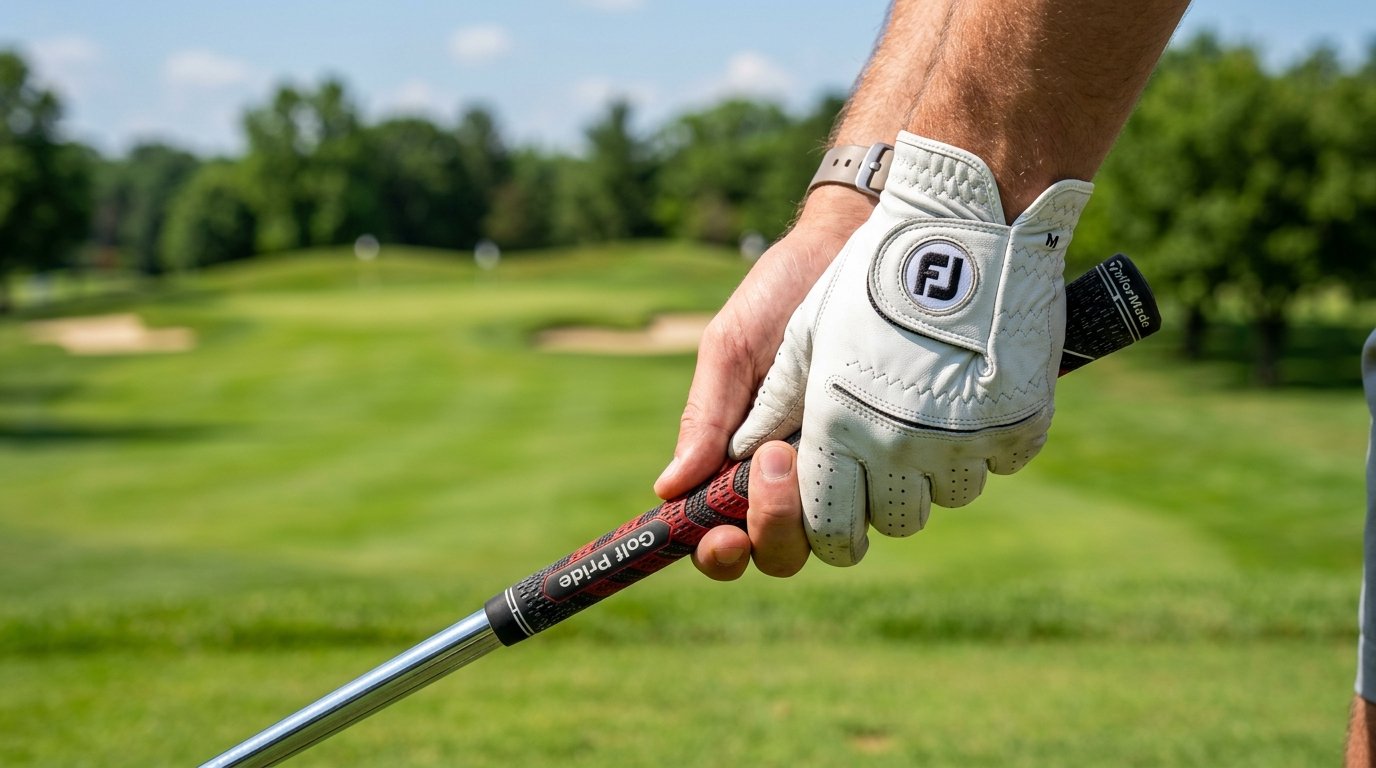
A golf glove goes on your lead hand, the hand that sits at the top of the grip. If you play right-handed, that’s your left hand. If you play left-handed, it’s your right hand. The other hand, your trail hand, stays bare for nearly every shot. This one rule holds true from junior golf all the way to the PGA Tour, and it comes straight from how a golf swing actually works.
Why does the glove go on the lead hand?
The lead hand does the heavy lifting in a golf swing. It sits at the top of the grip, wraps around the club first, and stays in contact with the handle through the entire motion, from address to follow-through. The trail hand mostly supports from below and adds speed through impact, but it slides and repositions more than the lead hand does.
Because the lead hand carries the most friction, it’s also the one most likely to blister or callus over a season of practice. A glove adds a layer of grip between skin and rubber, so your hand doesn’t have to squeeze as hard to hold on. That lets your forearms stay relaxed, which is exactly what a smooth swing needs. Leather and synthetic gloves also soak up sweat and rain, so your hold on the club stays steady even when conditions turn humid.
How do I know which hand is my lead hand?
Match the glove to the way you swing, not the hand you write with. A right-handed golfer swings with the left hand on top of the grip, so the glove goes on the left hand. A left-handed golfer swings with the right hand on top, so the glove goes on the right hand.
Glove labels follow the same logic. A glove marked LH is built for a left hand, and one marked RH fits a right hand. A small number of players write with one hand but golf from the other side, so it’s worth checking your actual grip and stance before you buy, rather than assuming from your handwriting.
Why do golfers wear only one glove?
Wearing a single glove is partly practical and partly about feel. The trail hand takes less friction during the swing, so many golfers prefer to leave it bare and keep direct contact with the club. That bare hand picks up more feedback about clubface position and impact, something a lot of players value on delicate shots around the green.
There’s also a cost and habit factor. Replacing one glove costs less than replacing two, and one-glove golf has simply been the norm for generations, so most players never think to change it.
When do golfers wear two gloves?
Some golfers do wear a glove on both hands, and there are real reasons for it. Cold weather is one: an extra glove keeps the trail hand warm without giving up grip on the lead hand side. Wet or humid rounds are another, since a second glove cuts down on slipping when sweat or rain make bare skin unreliable. A handful of touring pros, including Tommy Gainey, wear two gloves simply because it suits their swing and gives them a stronger connection to the club through impact.
The trade-off is feel. A glove on the trail hand dulls the sense of contact many golfers rely on for touch shots, so most players who try two gloves save the second one for rough weather rather than wearing it every round. If you want to test it, keep a second glove in your bag for rain and cold snaps rather than buying a matched pair for every round.
Do you take the glove off to putt?
Yes, most golfers slip the glove off before putting and chipping. Feel matters more than grip on these shots, since you’re trying to sense the clubhead and control distance rather than fight friction or power through the ball. Bare skin on both hands gives you a truer read of contact, and it’s part of why you’ll see gloves come off, get tucked under a strap or clipped to a bag, right before a golfer steps onto the green. Taking it off between shots also helps the glove last longer, since leather in particular breaks down faster with constant wear.
Leather or synthetic: which glove material should I pick?
Most golf gloves are made from cabretta leather, synthetic material, or a mix of both. Cabretta leather comes from a type of sheep and it’s the softest option, molding to your hand within a round or two and giving the closest feel to bare skin. That softness comes at a cost. Leather stretches when it’s wet and stiffens when it dries out in the sun, so a leather glove worn in the rain or heavy sweat wears out faster than one used in dry conditions.
Synthetic gloves, usually made from microfiber or a similar woven material, trade some of that soft feel for durability. They hold their shape longer, resist water better, and cost less to replace, which makes them a common choice for golfers who play often or in wet climates. Hybrid gloves mix leather across the palm, where feel matters most, with synthetic panels on the back and fingers, where stretch and airflow matter more. None of the three is wrong. It comes down to how often you play and whether you value feel or durability more.
How do I find the right glove size?
Roughly half of golfers wear a glove that’s the wrong size, and almost all of those are wearing one too big. A loose glove bunches at the fingertips and lets the club shift slightly in your hand, which works against the entire reason for wearing one.
Getting an accurate fit takes about a minute. Measure the circumference of your lead hand around the knuckles, leaving out the thumb. Then measure the length of your middle finger from the base of your palm to the tip.
Compare both numbers to a manufacturer’s chart, since sizing shifts slightly between brands. FootJoy’s glove fitting guide walks through the same two measurements with a printable ruler, which is a fast way to check your size before ordering online. Golfers with a wider palm and shorter fingers often fit better in a cadet size, which is cut wider and shorter than a regular glove of the same circumference, rather than sizing up in the regular line.
A properly sized glove should feel snug across the palm with almost no loose material at the fingertips, but you should still be able to close your hand into a full fist without strain.
How long does a golf glove last?
A golf glove doesn’t last forever, and pushing one past its useful life defeats the purpose of wearing it. Watch for thinning or shiny patches across the palm and fingers, a loss of the slightly tacky texture new gloves have, and a fit that has stretched loose even though you bought the right size. Small holes near the seams or at the base of the fingers are another clear sign it’s time for a new one.
A golfer who plays once or twice a week can expect a leather glove to last somewhere around 10 to 20 rounds before it noticeably loses grip, though this varies with sweat, humidity, and how often you clean it. Synthetic gloves typically stretch that range further. Rotating two or three gloves and letting each one dry out fully between rounds is the simplest way to add life to any glove, leather or synthetic.
Is a golf glove required by the rules?
No. A glove is optional equipment, not a requirement to play a legal round. Most golfers wear one anyway because the grip benefit is worth it. Under the USGA’s equipment rules, a glove is allowed as long as it’s plain, meaning a fitted covering with a separate sheath for each finger, made of smooth material across the palm, with no added padding beyond a small tolerance. Golfers who need padding for a medical reason, such as arthritis, can petition their committee for an exception, but a standard glove off the shelf already meets the rule without any extra steps.
Conclusion
The glove goes on your lead hand, left for right-handed golfers and right for left-handed golfers, because that hand carries the most friction and control through the swing. Wearing the correct size, taking it off for putting, and reaching for a second glove only in rain or cold will keep your grip steady and your hands protected all season.
Frequently asked questions
Do left-handed golfers wear the glove on the opposite hand?
Yes. Left-handed golfers wear the glove on the right hand, since that’s their lead hand at the top of the grip. Right-handed golfers wear it on the left.
Why do golfers only wear one glove?
The lead hand takes most of the friction and needs the extra grip, while the bare trail hand keeps more feel for touch shots. Wearing one glove also costs less than replacing two.
Can you wear a golf glove on both hands?
Yes. Some golfers wear two gloves in cold or wet conditions for extra grip and warmth, though it can reduce the feel most players want around the green.
Do you need to wear a glove for putting?
No. Most golfers remove the glove for putting and chipping, since bare skin gives a truer sense of contact on shots where feel matters more than grip strength.
How do I know what size golf glove to buy?
Measure your lead hand’s circumference around the knuckles, excluding the thumb, and your middle finger’s length. Compare both numbers to the glove brand’s size chart, since fit varies between makers.
Related Articles
How to Wash Golf Gloves Without Wrecking Them?
How to Measure Golf Shaft Length (Step-by-Step Guide)
How Much Does a Golf Ball Weigh?
How Many Clubs Are in a Golf Bag? (14-Club Rule)