
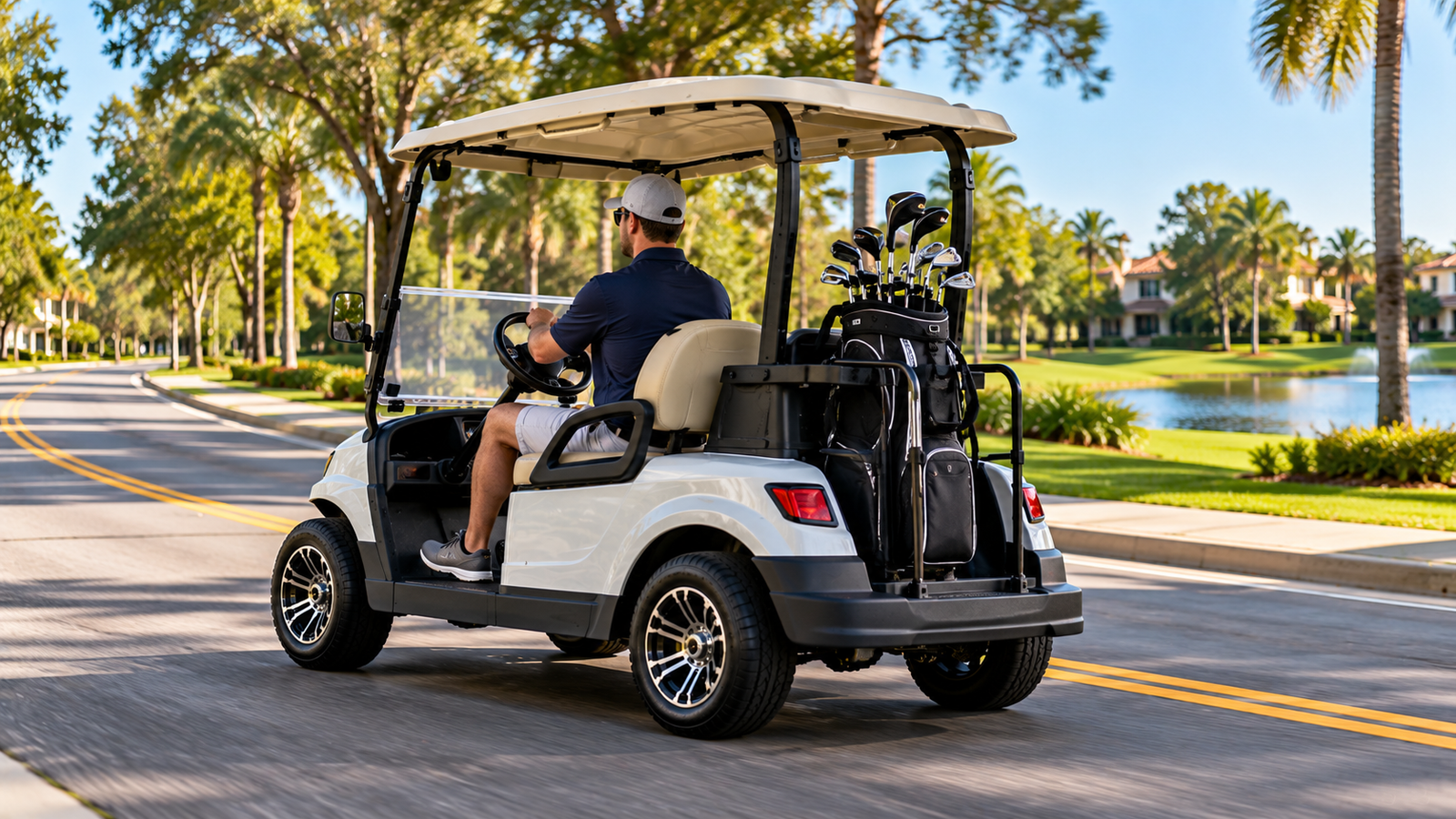
Sometimes yes, but rarely without conditions. Whether you can legally drive a golf cart on a public road comes down to two things: what the vehicle actually is under the law, and what your state and town allow. A standard golf cart and a street-legal low-speed vehicle can look almost identical in a parking lot, yet the law treats them very differently. Below is exactly when a golf cart can go on the road, what you need to make it legal, and where you will still get pulled over.
Golf cart or low-speed vehicle? The difference decides everything
A golf cart is built to move players and clubs around a course. It usually tops out around 15 miles per hour, and it comes with no seat belts, no turn signals, and no windshield rated for road use. In legal terms, that makes it off-road equipment, not a car.
A low-speed vehicle, often called an LSV or a neighborhood electric vehicle, is a real motor vehicle in the eyes of the federal government. It has four wheels, weighs under 3,000 pounds fully loaded, and can go between 20 and 25 miles per hour. It also carries the safety gear a car needs. That gear is what earns it a spot on public streets.
The federal rules for an LSV live in a single safety standard, Federal Motor Vehicle Safety Standard No. 500. To meet it, the vehicle needs headlights, brake lights, tail lights, turn signals, reflectors, mirrors, a parking brake, a windshield, seat belts, and a vehicle identification number. Fit all of those, register it, and it becomes street legal in most places. Miss them, and it stays a golf cart in the eyes of the law.
Here is the quick way to tell the two apart:
| Feature | Golf cart | Low-speed vehicle (LSV) |
| Top speed | About 15 mph | 20 to 25 mph |
| Legal status | Off-road equipment | Registered motor vehicle |
| Safety equipment | Minimal or none | Full DOT set |
| VIN | Usually none | Required |
| Road use | Only where a local rule allows | Roads posted 35 mph or less |
| Registration & insurance | Not for course use | Required |
When can you drive a plain golf cart on the road?
A plain golf cart can go on a public road only when a local rule says so, and even then the road usually has to be slow. Most towns that allow it limit golf carts to streets posted at 30 or 35 miles per hour or less. The logic is simple: a 15 mph cart is dangerous when traffic around it is moving at 45.
Many places add more conditions on top of that. Daytime driving only is common, since a lot of carts lack proper lights. Some towns keep them off state highways completely and only allow you to cross at marked points. Others make you register the cart with the city and show a permit sticker before you take it out. A number of states also want a slow-moving vehicle triangle on the back, and working headlights and tail lights if you drive anywhere near dusk. None of these carts are meant to keep up with traffic, so the rules exist to keep them out of harm’s way.
A few communities were built around carts. Peachtree City in Georgia has more than 90 miles of cart paths, and The Villages in Florida is well known for letting residents run daily errands by cart. Those places are the exception, not the rule. Outside of golf-cart-friendly towns, driving one on a public street is often against the law by default, even if you see other people doing it.
Tip: Before you take a golf cart anywhere but a course or your own property, read your city or county ordinance. Golf cart rules are set locally, so two towns ten miles apart can have completely different laws.
State rules vary widely: three examples
Because there is no single national golf cart law, the rules shift the moment you cross a state line. Three states show how much the details change.
In South Carolina, a golf cart must be insured and registered with the state DMV, and it can only travel within 4 miles of the address on its registration or a gated community entrance. The driver has to be at least 16 with a valid license, and the road has to be posted at 35 miles per hour or less. Carts were once limited to daylight hours, and as of May 22, 2025, local governments can set their own time limits instead.
In Texas, golf carts can use public roads posted at 35 miles per hour or less, and you generally need a golf cart license plate from your county tax assessor-collector. That plate requirement is waived inside certain master-planned communities. Carts can cross a faster road at an intersection but cannot drive along it.
In California, a plain golf cart is mostly limited to designated areas, while a full low-speed vehicle can use roads posted at 35 miles per hour or less once it is registered and insured. The pattern repeats across the country: slower roads, real safety gear, and local sign-off.
How to make a golf cart street legal?
To drive a golf cart on the road legally in most areas, you either follow a local golf-cart ordinance or turn the cart into a low-speed vehicle. The LSV route is the one that works almost everywhere, so it is worth the effort if you plan to drive on real streets.
Turning a cart into an LSV means adding the equipment the standard requires, then registering it. Here is the usual list of what you need in place:
- Headlights, tail lights, and brake lights that work.
- Front and rear turn signals.
- A horn.
- Rearview and side mirrors.
- A windshield made from approved safety glass.
- Seat belts for every seat.
- Reflectors and a parking brake.
- Tires rated for street use.
Once the cart has the gear, you take it to your state motor vehicle office to get it titled and registered, the same way you would a car. The vehicle needs a VIN to do this. Many carts sold new as LSVs already have one, while an older cart converted at home may need a state inspection before a VIN is assigned. After that you buy insurance and bolt on a license plate, and the cart is ready for the road. A conversion kit and the registration fees add up, but the cost is small next to a single ticket or a crash without coverage.
Do you need a license, insurance, and registration?
For a street-legal LSV, the answer is usually yes on all three. You need a valid driver’s license to operate it, the same as any car. It must be titled and registered with your state, and it must carry at least the minimum insurance your state sets. In Florida, for example, that means a minimum of $10,000 in property damage liability and $10,000 in personal injury protection, plus a valid driver license behind the wheel. Florida lays out these low-speed vehicle rules on its state motor vehicle site.
For a plain golf cart driven under a local ordinance, the rules are lighter but not empty. Some towns ask for no license at all. Others set a minimum age, often 14 to 16, and want a learner’s permit. Florida now requires drivers under 18 to hold a learner’s or driver license to operate a golf cart on public roads, and adults to carry a government photo ID. Insurance and registration are usually not required for course or private use, but a town can still make you buy a local permit.
Where you can and can’t drive it?
Even a fully street-legal LSV is limited to slower roads. Federal and state rules keep low-speed vehicles on streets posted at 35 miles per hour or less. You can cross a faster road at an intersection, but you cannot drive down it. That rule keeps a 25 mph vehicle out of 50 mph traffic, where it would be a hazard.
A plain golf cart is more limited still. On approved routes it usually sticks to roads posted at 30 miles per hour or less. Sidewalks are off limits for both in most places, since they are meant for people on foot. Bike lanes and shared cart paths are a mixed bag and depend entirely on local rules, so never assume one is fair game. When you do cross a busier road, most laws want you to cross straight over at a right angle rather than merge into the lane, which again is about spending as little time as possible in fast traffic.
Parking lots, private property, and gated communities are the safest bet by far. On your own land or on a private community’s internal roads, you can usually drive a cart without meeting any road rules at all. The moment you cross onto a public street, though, the legal picture changes fast.
Does it matter if the cart is gas or electric?
No. The engine under the seat does not decide whether a cart is street legal. What matters is how fast it goes and what safety equipment it has. A gas cart and an electric cart face the same road rules, the same speed limits, and the same registration steps. The only place fuel type comes up is that many purpose-built low-speed vehicles happen to be electric, which is why the LSV category is sometimes called a neighborhood electric vehicle.
What happens if you drive one illegally?
Driving a golf cart on a road where it is not allowed can get you a traffic ticket, and the fine climbs if the cart is unregistered or uninsured where the law requires it. Because a cart offers little protection in a crash, a collision at road speed can cause serious injury, and you can be held responsible for the damage. If a child is driving without the required permit, the adult owner can be cited as well. The cost of a ticket and a possible lawsuit is far higher than the cost of proper equipment and registration, which is the real reason the LSV route is worth it.
Conclusion
So, can you drive a golf cart on the road? Only when the law and the vehicle line up. A plain cart is limited to slow, approved streets under a local rule, while a low-speed vehicle with full safety gear, a registration, and insurance can travel most roads posted at 35 miles per hour or less. Check your city ordinance first, upgrade to LSV spec if you want real freedom, and never take a bare cart into fast traffic.
Frequently asked questions
Can I drive a golf cart on the street without a license?
Usually not for a street-legal LSV, which needs a valid driver’s license. Some towns allow a plain golf cart under a local rule with only a minimum age or a learner’s permit, so check your local ordinance first.
What is the difference between a golf cart and an LSV?
A golf cart tops out around 15 mph and has little safety gear. A low-speed vehicle goes 20 to 25 mph, carries full lights, mirrors, seat belts, and a VIN, and is registered as a real motor vehicle.
How slow does a road have to be for a golf cart to be legal?
Most areas allow golf carts only on roads posted at 30 to 35 mph or less. Street-legal LSVs are held to the 35 mph limit too, though they may cross faster roads at an intersection.
Do I need insurance for a golf cart?
For course or private use, usually not. Once it is a registered low-speed vehicle on public roads, most states require insurance, often a set minimum for property damage and injury.
Can I make my old golf cart street legal?
Yes, in most states. Add the required lights, signals, mirrors, windshield, seat belts, and a parking brake, then title, register, and insure it as a low-speed vehicle. It may need a state inspection to get a VIN.
Related Articles
How Long Do Golf Cart Batteries Last?
How Much Does a Golf Cart Cost?
What Is a Cadet Golf Glove? A Simple Guide to Fit and Sizing
Do Golf Shoes Make a Difference?
[…] Can You Drive a Golf Cart on the Road? What’s Legal and What’s Not […]