
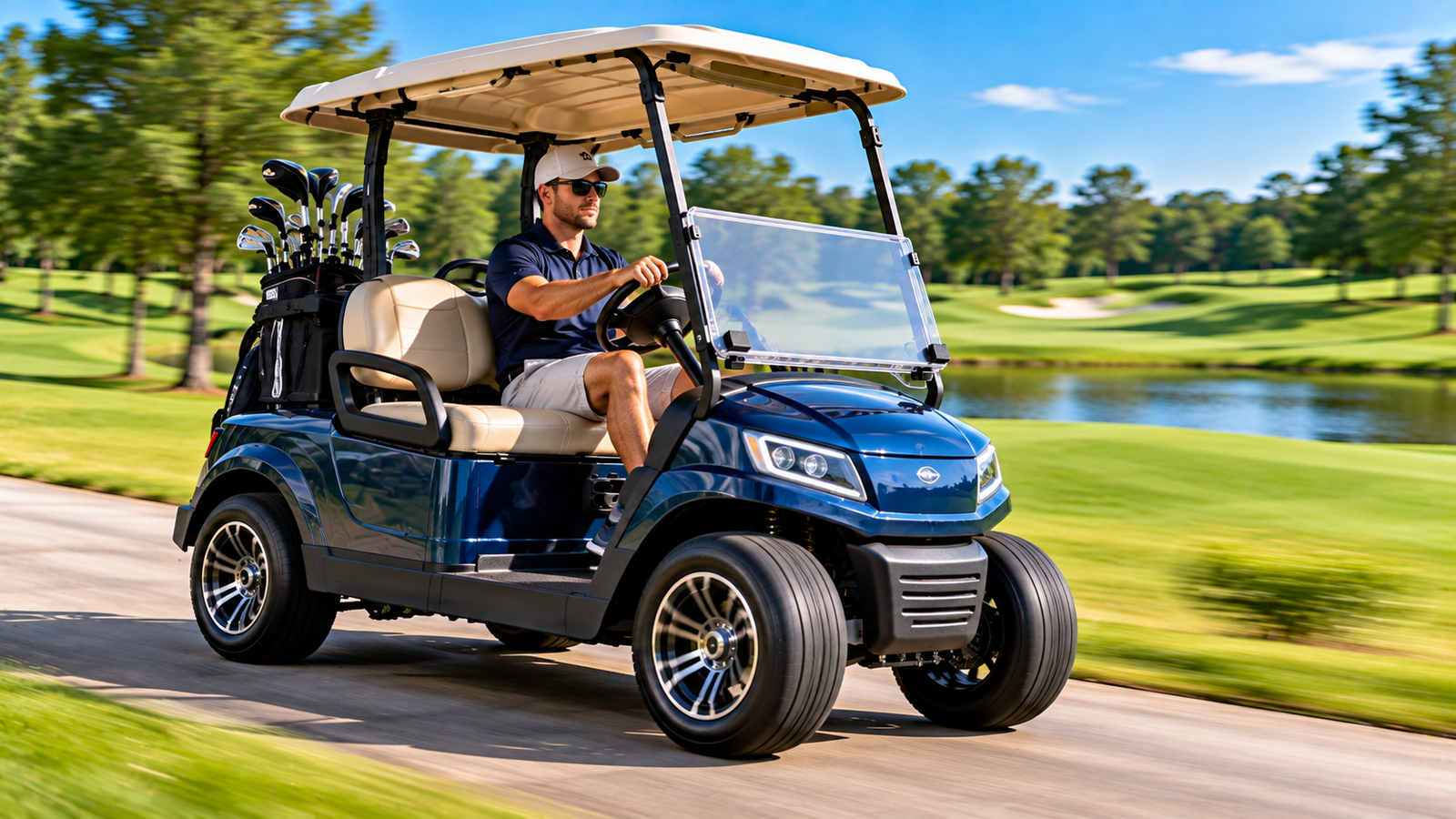
Most golf carts go 12 to 19 mph straight from the factory. Electric models usually top out around 12 to 15 mph, and gas models run a little faster at 15 to 19 mph. Street-legal versions built as low-speed vehicles can reach 25 mph, and a cart with the right upgrades can hit 25 to 35 mph or more.
Your exact top speed comes down to the motor, the batteries, the controller settings, and even your tires, and the same cart can post very different numbers depending on the load and the ground under it. Here is what to expect from each type of cart, where the speed actually comes from, and how far you can safely push it.
How fast is a standard golf cart?
A standard golf cart tops out at about 12 to 15 mph if it runs on electric power, and 15 to 19 mph if it runs on gas. That is the speed you get before any changes are made. Cart makers set this limit on purpose. A golf course is full of people walking, carts crossing paths, and tight turns near the greens, so a slower vehicle is easier to stop and far less likely to tip.
Most carts also cruise a little below their top figure in day-to-day use. A cart rated for 15 mph often settles around 12 to 13 mph once you add a passenger, a set of clubs, and a gentle slope. The rated number is the best case: flat, dry pavement with one light driver.
Fleet carts, the ones a course rents out by the round, are usually set even lower. Many are capped near 12 to 14 mph so every rider moves at a safe, predictable pace and the course stays orderly. A cart you buy for your own use tends to run at the higher end of its range, because you decide how and where it gets driven.
Typical top speeds by brand and model
Top speed shifts from one model to the next, mostly because of the drive system and how the maker programs it. The table below shows common factory speeds for popular carts.
| Cart | Type | Factory top speed |
| Club Car DS | Electric | 12 to 14 mph |
| Club Car Precedent | Electric | 14 to 15 mph |
| E-Z-GO TXT | Electric | 14 to 15 mph |
| E-Z-GO RXV | Electric | 15.5 mph |
| Yamaha Drive2 | Gas or electric | 17 to 19 mph |
| Club Car Onward LSV | Street legal | 19.5 mph |
| ICON i40 LSV | Street legal | 25 mph |
| Evolution D5 Maverick LSV | Street legal | 25 mph |
These are the speeds each cart reaches on flat, paved ground with a single rider. Add a second passenger or a hill and the number drops. The street-legal models sit at the top of the list because they are built and geared to keep up with slow neighborhood traffic, not just to circle a course.
Gas or electric: which one is faster?
Gas carts are usually a bit quicker, both off the line and at the top end, running around 15 to 19 mph against the 12 to 15 mph of a typical electric cart. A gas engine holds its power well on hills and does not fade as the day goes on, so it keeps that speed whether the tank is full or nearly empty.
Electric carts have closed most of that gap. A 48-volt electric cart with a strong motor can match or beat many gas models, and it does it quietly and with almost no upkeep. The catch is the battery. An electric cart is only as fast as its charge allows, so a low battery means a slower ride until you plug it back in.
There is a feel difference too. An electric motor gives full pull the instant you press the pedal, so it can feel snappier from a stop even when its top number is lower. A gas cart builds speed more gradually but pulls harder once it is moving and loaded.
For steady speed across a long day, gas still has a small edge. For quiet running, lower cost, and easy maintenance, electric wins, and on flat ground the speed is close enough that most drivers cannot feel the difference.
What is a low-speed vehicle, and how fast can it go?
A low-speed vehicle, or LSV, is a street-legal cart that can go faster than 20 mph but no more than 25 mph. This is a federal rule, not just a setting.
Under the national safety standard for low-speed vehicles, the top speed has to sit above 20 mph and at or below 25 mph. Go past 25 and the vehicle stops counting as an LSV, and it then has to meet the much stricter rules that apply to a full car.
To earn LSV status, the cart also needs real safety gear: headlights, brake lights, turn signals, mirrors, seat belts, a windshield, and a vehicle identification number. That gear is why an LSV can legally use many public roads with a speed limit of 35 mph or less, while a plain golf cart cannot. If you want to run errands or get around your neighborhood, this is the type to look for.
The 25 mph ceiling is a legal line, not a technical one. Many carts could be built to go faster, but crossing it would force them to meet full car safety rules, which raises the cost far beyond what a small vehicle is worth. So 25 mph has become the practical top speed for anything meant to share the road. Where you can actually drive still varies by state and city, so check your local limits before you buy.
What decides how fast your cart goes?
Several parts work together to set your top speed. Change one and the whole number moves.
- Motor and voltage. Voltage is the biggest lever. A 48-volt system pulls ahead of a 36-volt one, and higher-voltage setups can go faster still. A stronger motor turns that power into more speed and better pull on hills.
- Controller and governor. The controller is the brain that decides how much power reaches the motor, and many carts also have a governor that caps the top speed. This limiter is often what holds a cart back the most.
- Batteries. Weak or aging batteries cannot deliver full power, so the cart feels slow long before it should. Fresh batteries, or a switch to lithium, keep the speed steady and cut a lot of weight at the same time.
- Tires. Bigger tires cover more ground per turn, which raises your real top speed. The trade-off is a little less pull from a stop, so very large tires can make the cart feel sluggish at first.
- Weight and terrain. More passengers and cargo slow you down, and so do hills, wet grass, sand, and loose ground. The same cart that hits 15 mph on flat pavement may only manage 10 on a soft, uphill lawn.
These parts also depend on each other. A fast motor cannot show its speed if tired batteries starve it of power, and a lifted controller setting means little on worn tires. When a cart feels slower than it used to, the batteries are the usual cause, since they lose punch as they age even when they still hold a charge for range.
Do lifted golf carts go faster?
A lift kit on its own does not make a cart faster. All it does is raise the body so you can fit bigger tires and clear rough ground. Any speed change comes from the larger tires that usually go on with the lift, not the lift itself.
Those taller tires cover more distance with each turn of the wheel, so top speed can climb by a couple of miles per hour. The trade is slower pickup from a stop and a bit more strain on the motor, which now works harder to turn a heavier wheel. If speed is the only goal, a controller or motor upgrade does far more than a lift. Most people lift a cart for the look and the ground clearance, and treat any extra speed as a small bonus.
How to make a golf cart go faster
You can raise a cart’s top speed, and most of the gain comes from a handful of clear upgrades. Here they are, from the easiest to the most involved.
- Adjust or remove the governor. The governor caps your speed, so easing or removing it is often the quickest win. On many carts this one change adds 3 to 5 mph.
- Reprogram or upgrade the controller. A tuned or higher-output controller lets more power through to the motor, which turns into a real speed bump.
- Switch to lithium batteries. Lithium holds steady voltage and weighs far less than lead-acid, so the cart keeps its speed and feels lighter and quicker.
- Upgrade the motor. A higher-torque or high-speed motor is the core change for a big jump, and it works best paired with a matching controller.
- Fit larger tires. Taller tires raise top speed with no change to the motor, though you give up a little launch power in return.
Stack a few of these and a 48-volt cart can reach roughly 22 to 28 mph, while a full performance build can push past 35 mph. The smartest order is to start with the free change, the governor, then add fresh batteries and a controller before you touch the motor. That way you feel each gain, and you avoid paying for a fast motor that weak batteries cannot feed.
Pushing a cart faster than its parts were built for wears out brakes, tires, and the motor sooner, and it can void your warranty. Upgrade the brakes and suspension alongside the speed, not after.
How fast is safe, and is it legal?
Speed and safety pull against each other on a cart. Golf carts sit high, have a short wheelbase, and often have no seat belts or doors, so they can tip in a sharp turn or throw a rider who is not holding on. Makers set the stock limit where they do for that reason. Pushing a basic cart well past its design speed raises the risk of a rollover, and that risk climbs with passengers or on a slope.
If you do raise the speed, upgrade the brakes, tires, and suspension to match. A cart that stops and handles like a 14 mph vehicle is not safe at 25. Better tires grip harder, stronger brakes cut the stopping distance, and a firmer suspension keeps the cart planted in turns.
The law matters just as much. A standard golf cart is meant for a course or private land, not public roads. To drive legally on the street you need an LSV with the required safety gear, and even then you are limited to roads with lower speed limits. Before you modify a cart or take it out on the road, check your state and local rules so you stay both safe and legal.
Conclusion
Most golf carts go 12 to 19 mph out of the box, with electric models near the low end and gas models near the high end. Street-legal LSVs reach 25 mph, and a well-built custom cart can top 35. Your real speed comes down to the motor, batteries, controller, tires, and load. Decide how you will use the cart, match the type to that job, and keep any speed upgrades within safe and legal limits.
Frequently asked questions
How fast does a golf cart go without a governor?
Removing or easing the governor usually adds about 3 to 5 mph. A typical electric cart that ran 14 mph might reach 17 to 19 mph, though the exact gain depends on your motor, batteries, and controller.
Can a golf cart go 25 mph?
Yes. A street-legal low-speed vehicle is built to reach 25 mph, and a standard cart can get there with upgrades like a stronger motor, lithium batteries, and a tuned controller. Anything past 25 mph loses LSV status.
Are gas or electric golf carts faster?
Gas carts are usually a little faster, around 15 to 19 mph versus 12 to 15 for electric. A strong 48-volt electric cart can match many gas models, so the gap is smaller than it used to be.
How fast can a 48-volt golf cart go?
A stock 48-volt cart runs about 12 to 15 mph. With upgrades to the controller, batteries, motor, and tires, a 48-volt cart can reach roughly 22 to 28 mph.
Is it legal to drive a golf cart on the road?
Only in some places, and usually only if it is registered as an LSV with headlights, signals, mirrors, and seat belts. Rules vary by state and city, so check local law before driving on any public road.
Related Articles
Can You Drive a Golf Cart on the Road? What’s Legal and What’s Not
How Long Do Golf Cart Batteries Last?
How Much Does a Golf Cart Cost?
What Is a Cadet Golf Glove? A Simple Guide to Fit and Sizing
[…] How Fast Can a Golf Cart Go? Real Top Speeds by Type […]
[…] How Fast Can a Golf Cart Go? Real Top Speeds by Type […]