
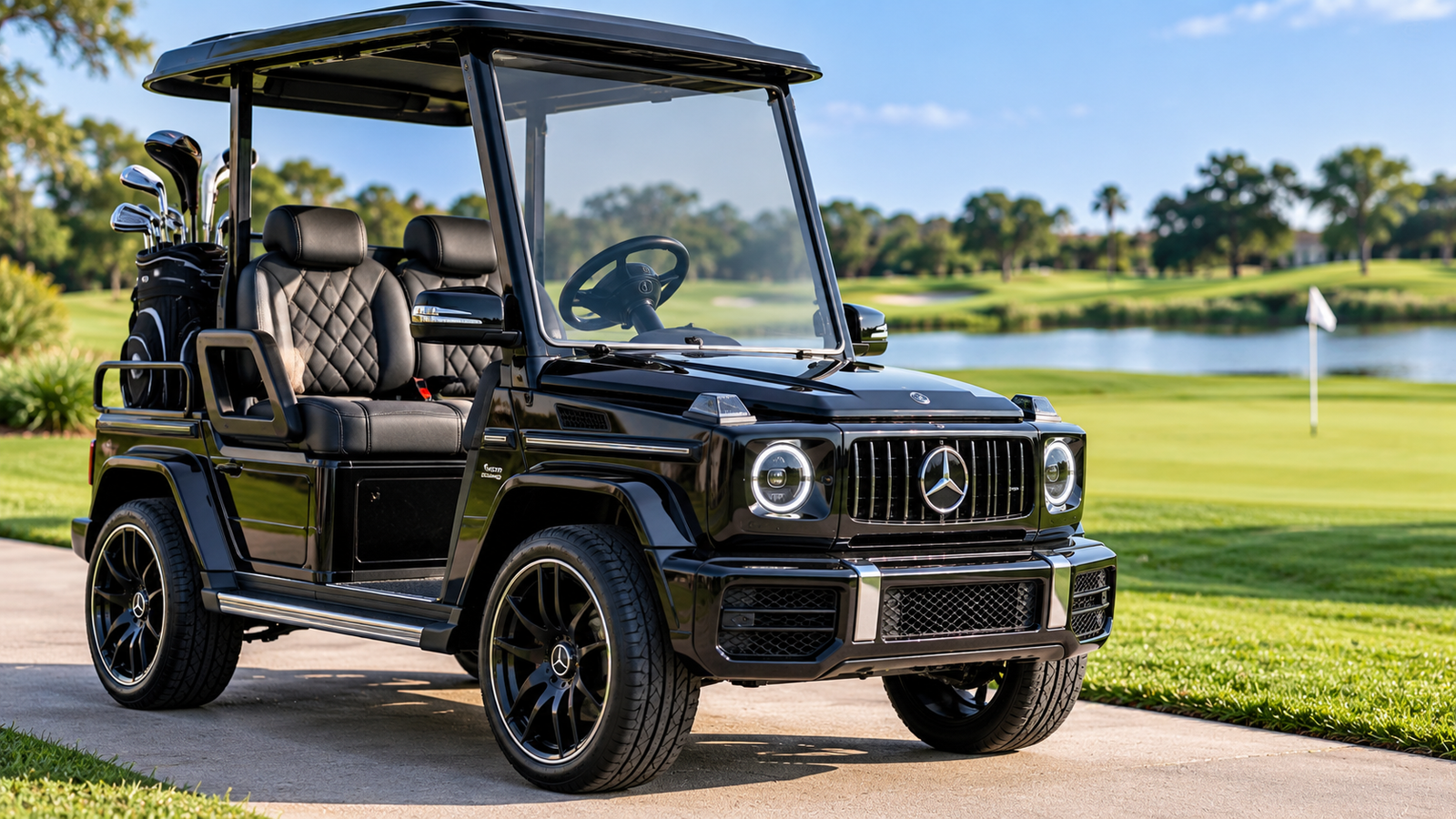
A mini G Wagon golf cart is a Mercedes G-Class styled electric low-speed vehicle built on a standard golf cart chassis, usually priced between $20,000 and $25,000. It has no connection to Mercedes-Benz. Builders take a four-seat electric platform, add a boxy fiberglass body, round headlights, and a side-mounted spare tire, and sell the result under names like the G600, the E-Wagon, or the Bodo G-Wagon. Here’s what you actually get for that price, and what to check before you buy one.
What is a mini G Wagon golf cart?
It’s an electric golf cart with a custom body kit designed to look like a scaled-down Mercedes G-Class. The frame, motor, and battery underneath come from ordinary golf cart or low-speed vehicle manufacturing, not from Mercedes-Benz or any of its suppliers.
Several sellers build their own version of this cart and market it under different names. The G600 and E-Wagon G600 show up most often in listings, and you’ll also see it called the Bodo G-Wagon. The name changes by seller, but the formula stays the same: a boxy body over a golf cart drivetrain, built to turn heads at the club, in a gated community, or on a resort street.
The look is convincing from a distance. Up close, the scale gives it away immediately. A real G-Class is roughly 76 inches tall and weighs over 5,600 pounds. These carts stand closer to a normal golf cart’s height and weigh a few hundred pounds, closer to a heavy riding mower than an SUV.
The appeal isn’t really about fooling anyone. It’s about standing out on a golf course or in a gated community where every other cart looks the same. A boxy, squared-off shape with round headlights and a spare tire mounted on the back reads as distinctive parked next to a row of standard white carts, even though everyone involved knows exactly what it is.
Builders reach this look by fitting a fiberglass or composite body kit over an existing four-seat electric cart frame. That’s the same basic approach used for other novelty-styled carts, from Jeep-look models to classic truck replicas. The G-Class shape happens to translate especially well to a boxy golf cart silhouette, which is part of why it caught on faster than most other styling kits.
How much does a mini G Wagon golf cart cost?
Most listings price the mini G Wagon golf cart between $20,000 and $25,000. The 2026 E-Wagon G600, one of the more visible versions on dealer sites, lists an MSRP of $24,999 with sale pricing often closer to $21,950.
That’s a wide gap from an ordinary golf cart, which typically runs $8,000 to $15,000 new, and it puts this cart within range of a used compact car. The premium pays for the body kit, the interior tech, and the branding, not for anything that changes how the cart drives. Customization, paint, and dealer add-ons can push the price higher still.
A four-seat electric LSV with a Mercedes-style body typically costs $20,000 to $25,000, roughly double what a comparable plain golf cart costs.
Financing works the same way it does for other LSVs. Some dealers offer in-house payment plans, and because these carts carry a VIN when properly certified, a handful of lenders will treat them like a small vehicle purchase rather than a cash-only recreational item.
Ask about financing terms early, since not every dealer advertises it up front, and the terms can vary a lot between an established golf cart retailer and a smaller import-focused seller.
Resale is worth thinking about before you buy, not after. A cart bought for the novelty factor tends to depreciate faster than a mainstream LSV from a recognized brand, because the resale market is smaller and buyers are more cautious about unfamiliar names.
If you plan to keep the cart for many years rather than sell it in two or three, that matters less. If resale value matters to you, factor it into the price you’re willing to pay now.
What are the specs and performance like?
Specs vary a bit by seller, but the numbers cluster tightly enough to give a reliable picture of what you’re buying.
| Spec | Typical figure |
| Seating | 4 passengers |
| Motor | Brushless DC electric motor |
| Battery | Lithium pack, up to about 10 kWh |
| Top speed | About 25 mph |
| Range | Up to about 80 miles per charge |
| Comfort features | AC and heat, power windows and locks, power steering, rearview camera, dual rear entertainment screens |
| Brakes | 4-wheel disc brakes with brake boost on most current models |
On paper, that’s a strong spec sheet for an LSV. The 80-mile range and 25 mph top speed compare well against other electric low-speed vehicles, and the interior tech, especially the AC and rear screens, goes well beyond a bare golf cart. The motor itself is modest. Reported output sits around 20 horsepower, which is plenty for neighborhood streets and golf course paths but nowhere near what a comparable-looking full-size SUV produces.
Real-world range depends heavily on load, terrain, and how much you run the AC, so treat the advertised figure as a best case rather than a guarantee.
The lithium battery packs used in current models charge faster and last longer than the older lead-acid packs still found on cheaper builds and some used listings.
A lithium pack typically handles more charge cycles before it loses meaningful capacity, and it weighs less, which helps both range and handling. If you’re comparing two listings at a similar price, the battery chemistry is one of the first specs worth checking, since it affects both day-to-day range and how much you’ll spend on a replacement pack years down the road.
The interior tech is where these carts pull furthest ahead of a bare-bones golf cart. Dual rear entertainment screens, a large front touchscreen with Bluetooth, steering wheel controls, and a rearview camera are common even on base configurations. Power windows, an electric parking brake, and auto-hold add a level of convenience closer to a small car than a cart.
None of that changes the underlying drivetrain, but it does change how the cart feels to ride in day to day, especially for families using it around a resort or neighborhood rather than strictly for golf.
Is a mini G Wagon golf cart street legal?
It can be, but only if it’s properly built and registered as a low-speed vehicle. Street legal status depends on documentation and equipment, not on how the cart looks or what the seller’s marketing claims.
Federal rules set the baseline. Under Federal Motor Vehicle Safety Standard 500, a low-speed vehicle needs seat belts, headlights, taillights, turn signals, a horn, mirrors, and a windshield, and it must carry a proper 17-digit Vehicle Identification Number. Each state then adds its own registration and licensing rules on top, and most cap LSV use to roads posted at 35 mph or below.
Before you buy, ask the seller three direct questions: what VIN the cart carries, what LSV certification backs it, and how they support registration in your state. A seller who can’t answer clearly, or who treats the question as a formality, is a warning sign. Having the right equipment installed is not the same as having a cart that’s certified and titled correctly from the start, and fixing that after the fact can be far more expensive than buying it right the first time.
The National Highway Traffic Safety Administration publishes the full FMVSS low-speed vehicle standard, which is the document any seller’s certification should trace back to.
States handle the details differently once the federal baseline is met. Some require a standard driver’s license to operate an LSV on public roads, while others allow a lower age or a restricted permit for use inside a gated community or resort. Insurance requirements also vary.
Many states treat a properly registered LSV like any other titled vehicle for insurance purposes, which means you’ll need a policy and proof of coverage, not just a bill of sale. Check your state’s specific rules before you assume the cart can go straight from the dealer’s lot onto a public street.
What should you check before buying one?
Because these carts come from small import builders rather than established golf cart manufacturers, the questions that matter most are about the company behind the cart, not the styling.
- Confirm the brand and builder. Ask exactly who manufactures the cart and how long they’ve been in business, since several sellers rebrand the same or similar product.
- Get the VIN and LSV paperwork in writing before you pay a deposit, not after delivery.
- Ask about parts and service. Established golf cart brands carry dealer networks and stocked parts. Import-style novelty carts often don’t, which matters the first time something breaks.
- Check the warranty terms closely, including what’s covered on the battery and motor, since those are the most expensive parts to replace.
- Compare the total price against a well-known LSV brand with similar range and speed, so you know exactly what premium you’re paying for the styling.
None of this means the cart runs poorly when it’s new. It means the ownership picture, resale value, and long-term support carry more risk than the glossy listing photos suggest. A recognized brand tends to hold value better simply because buyers know the name and know parts exist. A novelty cart with inconsistent branding across sellers can become a much harder sell three or four years down the line.
If you want the boxy, rugged look without the ownership questions, it’s worth cross-shopping standard LSV brands like Club Car’s Villager 2 LSV line, which meets the same street-legal standards with an established dealer network behind it.
It also helps to test drive the exact cart you’re considering, not a similar-looking one from a different batch. Small import builders can vary quality between production runs, so panel gaps, paint finish, and how solid the doors feel can differ even within the same model name. A short test drive on a bumpy surface will tell you more about suspension and body rigidity than any spec sheet.
Finally, ask what happens if the company disappears. Several of these builders are small operations without a long track record, and if the manufacturer stops trading, warranty support and parts sourcing can dry up fast. A local dealer with its own service department, rather than a seller who only ships the cart and disappears, gives you a much better safety net if something goes wrong in year two or three.
Conclusion
A mini G Wagon golf cart gives you a genuine head-turning look, real amenities like AC and rear screens, and LSV performance that holds up on paper, all for $20,000 to $25,000. The styling has nothing to do with Mercedes-Benz, and the value of the purchase comes down to documentation. Get the VIN, the LSV certification, and clear answers on parts and service before you buy, and you’ll know exactly what you’re getting for the price.
Frequently asked questions
Is the mini G Wagon golf cart made by Mercedes-Benz? No. Mercedes-Benz has no affiliation with it. Independent builders style a standard golf cart chassis with a G-Class-inspired body kit.
How much does a mini G Wagon golf cart cost? Most models list between $20,000 and $25,000, with the E-Wagon G600 priced around $21,950 to $24,999 depending on the dealer and options.
How fast does it go and how far on a charge? Most models top out around 25 mph and cover up to about 80 miles on a full charge of their lithium battery pack, though real-world range varies with load and terrain.
Can you drive a mini G Wagon golf cart on public roads? Only if it’s built and registered as a low-speed vehicle with the required equipment and a valid VIN, and only on roads posted at 35 mph or below in states that allow it.
Is it a good long-term investment compared to a standard golf cart? It costs roughly double a comparable plain LSV for styling alone, and resale value depends heavily on the builder’s reputation, so weigh that against a recognized brand before buying.
Related Articles
Do Golf Balls Go Bad? The Real Answer
Bucket of Golf Balls: Sizes, Cost, and How Many You Need
What Is Par in Golf? A Clear, Complete Guide
Golf Glove for Right-Handed Golfers: How to Get the Right Fit
[…] Mini G Wagon Golf Cart: Price, Specs, and Buying Guide […]
[…] Mini G Wagon Golf Cart: Price, Specs, and Buying Guide […]