
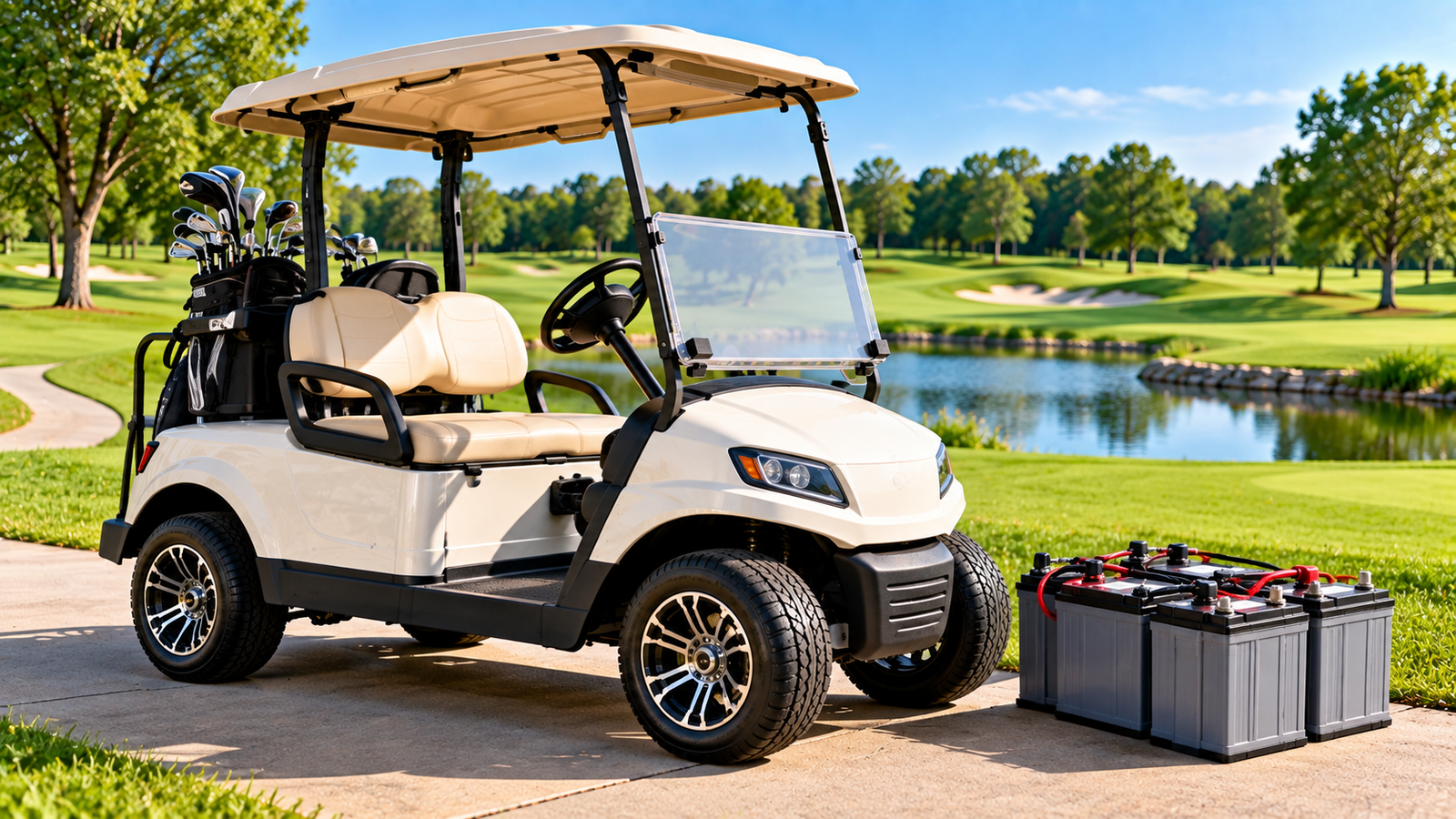
Most golf cart batteries last between 3 and 10 years, and the type you own decides where you land in that range. Flooded lead-acid batteries, the kind in most older and budget carts, usually run 3 to 5 years. AGM and gel batteries stretch that to about 4 to 6 years. Lithium batteries, now common in newer carts, can last 8 to 10 years or more.
Two carts with the same battery can still age very differently. How often you drive, how you charge, the weather where you park, and whether you keep up with simple upkeep all move the number up or down. Here is what to expect from each type, what wears a battery out early, and how to get every good year out of the set you have.
How long does each type of golf cart battery last?
The battery chemistry sets the ceiling. A cart that runs a few times a week and gets charged and maintained well will reach the top of its range. A fleet cart at a course or resort, used all day and charged hard, tends to sit at the bottom.
The other measure that matters is charge cycles. One cycle is a full drain and recharge. A battery has a rough budget of cycles, and each type carries a different number.
| Battery type | Charge cycles | Typical lifespan |
| Flooded lead-acid | 300 to 500 | 3 to 5 years |
| AGM / gel | 500 to 700 | 4 to 6 years |
| Lithium (LiFePO4) | 2,000 to 5,000+ | 8 to 10+ years |
A personal cart used for errands or a few holes a week often gets 6 to 10 years out of lead-acid batteries, because it goes through far fewer cycles. The same batteries in a rental fleet may need swapping in 4 to 6 years. Lithium holds up better under heavy use, which is a big reason courses and serious daily drivers have moved to it.
It also helps to know what you are actually replacing. A golf cart does not run on one battery. It runs on a pack of several wired together to make 36 or 48 volts. A 36-volt cart usually uses six 6-volt batteries. A 48-volt cart uses four 12-volt, six 8-volt, or eight 6-volt batteries. Lithium carts often do the same job with one or two larger units. When people talk about a battery lasting five years, they mean the whole set, and when it is time, you replace them all together.
What shortens a golf cart battery’s life?
A few habits and conditions do most of the damage. Knowing them tells you exactly what to change.
Deep discharges are the biggest one for lead-acid packs. Running a flooded battery down near empty over and over eats through its cycle budget fast. Draining it flat, then leaving it that way, is worse. When a lead-acid battery sits discharged, hard crystals of lead sulfate build up on the plates and stop taking a charge. This is called sulfation, and enough of it can wreck a set in a single season.
Overcharging does the opposite kind of harm. Leaving a battery on a cheap charger with no automatic shut-off boils off the water and cooks the plates over time. A good charger that stops on its own prevents both problems.
Heat is next. High temperatures speed up the chemical wear inside every battery type. A cart baking in a closed shed through summer ages faster than one kept somewhere cool and shaded. Hard cold hurts too. It cuts how much range you get on a charge and, in flooded batteries, can freeze a discharged one.
For flooded lead-acid batteries, low water is a quiet killer. The plates need to stay covered. Let the water drop until the tops of the plates are exposed to air, and that part of the plate is damaged for good.
The rest of the list is smaller but adds up: charging with the wrong charger or an old, tired one, skipping charges so the battery sits partly drained for days, mixing new batteries with old ones in the same pack, and running heavy loads like steep hills or a lifted cart with oversized tires. Each one shaves months off the total.
Does the way you drive change how long they last?
Yes, and often by years. Every steep hill, heavy load, and hard start pulls more current, and more current means faster wear. A cart that climbs hilly ground all day, carries four adults, or runs oversized tires on a lift kit drains its pack harder than a cart cruising flat, paved paths with one or two people aboard.
Short, frequent hops are gentler than long full-throttle runs, as long as you charge between heavy days. Speed matters too. Flooring it from every stop draws a big surge each time, while steady, smooth driving is easier on the batteries and gives you more range per charge.
Where you keep the cart counts as much as how you drive it. A pack that lives in a hot garage or bakes in the sun ages faster than one parked in the shade or a climate-controlled space. If you can only change one thing about a hard-worked cart, ease off the throttle and give it a full charge at the end of every day.
What are the signs your golf cart battery is dying?
Your cart will tell you before the battery quits for good. Watch for these five signs.
- Shorter range. A healthy cart handles a full round or a day of errands on one charge. When it can only go a mile or two before it slows down or dies, the pack is near the end.
- Slow, weak power. The cart feels sluggish off the line and struggles on hills it used to climb without effort.
- Longer charge times, or a charge that will not hold. If a full charge starts taking much longer than usual, or drains away after a day sitting idle, the battery is losing capacity.
- Frequent watering. A flooded battery that suddenly needs water far more often than before is often overcharging and wearing out.
- Visible damage. Cracks, a swollen or bulging case, heavy white or blue corrosion on the terminals, or a puddle under the cart all point to a battery you should replace.
One weak battery in a pack drags down the whole set, so test the batteries individually rather than guessing. A voltmeter is the quick check. Let the pack rest for a few hours after charging, then read each battery. A healthy, fully charged 6-volt battery reads about 6.3 to 6.4 volts, an 8-volt about 8.4, and a 12-volt about 12.7. Any battery sitting well below the others is the weak link. For flooded batteries, a hydrometer that tests the fluid gives an even clearer picture, and a low reading in one cell points to a battery on its way out. A battery shop can run a proper load test if you want to be sure before you spend on a new set.
How can you make golf cart batteries last longer?
Good upkeep is simple, and it is the difference between a set that dies in three years and one that runs for six. Build these habits.
- Charge after every use. Plug in when you are done for the day, even after a short trip. Lead-acid batteries like to be stored full, not empty.
- Do not run them flat. Try to recharge lead-acid packs before they drop below about half. Lithium tolerates deeper use, but avoiding the very bottom still helps.
- Keep the water right (flooded only). Check the levels about once a month. Top up with distilled water until it sits a little above the plates, roughly an eighth of an inch, and add water after charging, not before. Trojan’s battery maintenance guide walks through the watering steps in detail.
- Use the correct charger. Match the charger to your pack’s voltage, and use one with automatic shut-off so you do not overcharge.
- Keep terminals clean. Wipe off corrosion with a baking soda and water mix, then make sure the connections are tight.
- Mind the temperature. Park and charge in a cool, dry, ventilated spot. In winter, keep a stored cart somewhere above freezing and give the battery a full charge before it sits.
Once a month, give flooded batteries a long, full charge and let the charger finish its whole cycle rather than pulling the plug early. Many chargers have an equalizing mode for this, which evens out the charge across the pack and clears light buildup on the plates. Check your charger’s manual before using it.
If you do only one thing, charge fully after every use and never leave the battery sitting empty. That single habit protects more lead-acid batteries than anything else.
For a cart you store over winter, charge it fully first, then either leave it on a smart maintenance charger or top it up every few weeks so it never sits low.
Lithium vs lead-acid: which lasts longer, and is it worth it?
Lithium lasts longer, plain and simple, and for most owners the higher price pays for itself. A lead-acid set runs $800 to $1,500 and lasts 3 to 5 years. AGM sits around $1,200 to $2,000 for 4 to 6 years. A lithium (LiFePO4) pack costs more up front, roughly $2,000 to $3,500, but it lasts 8 to 10 years or longer.
Look at a 10-year window and the math shifts. You may buy two or three lead-acid sets in the time one lithium pack lasts. Lithium also charges in 2 to 5 hours instead of 8 to 10, needs no watering, weighs less, and gives steady power right down to a low charge instead of fading as it drains.
Lead-acid still makes sense if you want the lowest price today, you drive lightly, and you do not mind the upkeep. If you use the cart hard, want to skip maintenance, or plan to keep it for many years, lithium is usually the better long-term buy.
One more thing to weigh: warranty and weight. Lithium packs often carry longer warranties, which tells you how much life the maker expects. They also cut a lot of weight, which frees up the motor and adds a little range. If you switch a lead-acid cart to lithium, check that your charger and, on some carts, the controller can handle the new pack, since lithium charges differently.
Conclusion
Plan on 3 to 5 years from flooded lead-acid batteries, 4 to 6 from AGM, and 8 to 10 or more from lithium, with light use and good care pushing every type higher. The habits that matter most are charging fully after each use, never leaving the pack empty, keeping flooded batteries watered, and parking somewhere cool. Do those, watch for shorter range and slow power, and you will get the most life and the fewest surprises from your set.
Frequently asked questions
How often should I replace golf cart batteries?
Replace flooded lead-acid batteries every 3 to 5 years, AGM every 4 to 6, and lithium every 8 to 10 or more. Go by performance too: once range and power drop sharply and a charge will not hold, it is time.
Can I replace just one bad golf cart battery?
It is better to replace the whole set. A new battery paired with old ones gets dragged down to their level and wears out fast, so you lose the benefit and often the new battery too.
How long does a golf cart battery hold a charge when not used?
A healthy battery holds a usable charge for a few weeks, but it slowly self-discharges. For longer storage, charge it fully first and top it up every few weeks or leave it on a maintenance charger.
Do golf cart batteries last longer than car batteries?
Usually, yes. Golf cart batteries are deep-cycle, built to drain and recharge daily, so they often outlast the 3 to 5 years of a standard car battery when cared for well.
Is it worth switching from lead-acid to lithium?
For heavy use or long-term ownership, yes. Lithium costs more up front but lasts two to three times as long, charges faster, and needs no watering, so it often costs less over 10 years.
Related Articles
What Golf Balls Do Pros Use? The Models Behind the Wins
How to Clean Golf Shoes Without Wrecking Them?
Do Golf Shoes Make a Difference?
What Is a Cadet Golf Glove? A Simple Guide to Fit and Sizing
[…] How Long Do Golf Cart Batteries Last? […]
[…] How Long Do Golf Cart Batteries Last? […]
[…] How Long Do Golf Cart Batteries Last? […]
[…] How Long Do Golf Cart Batteries Last? […]