
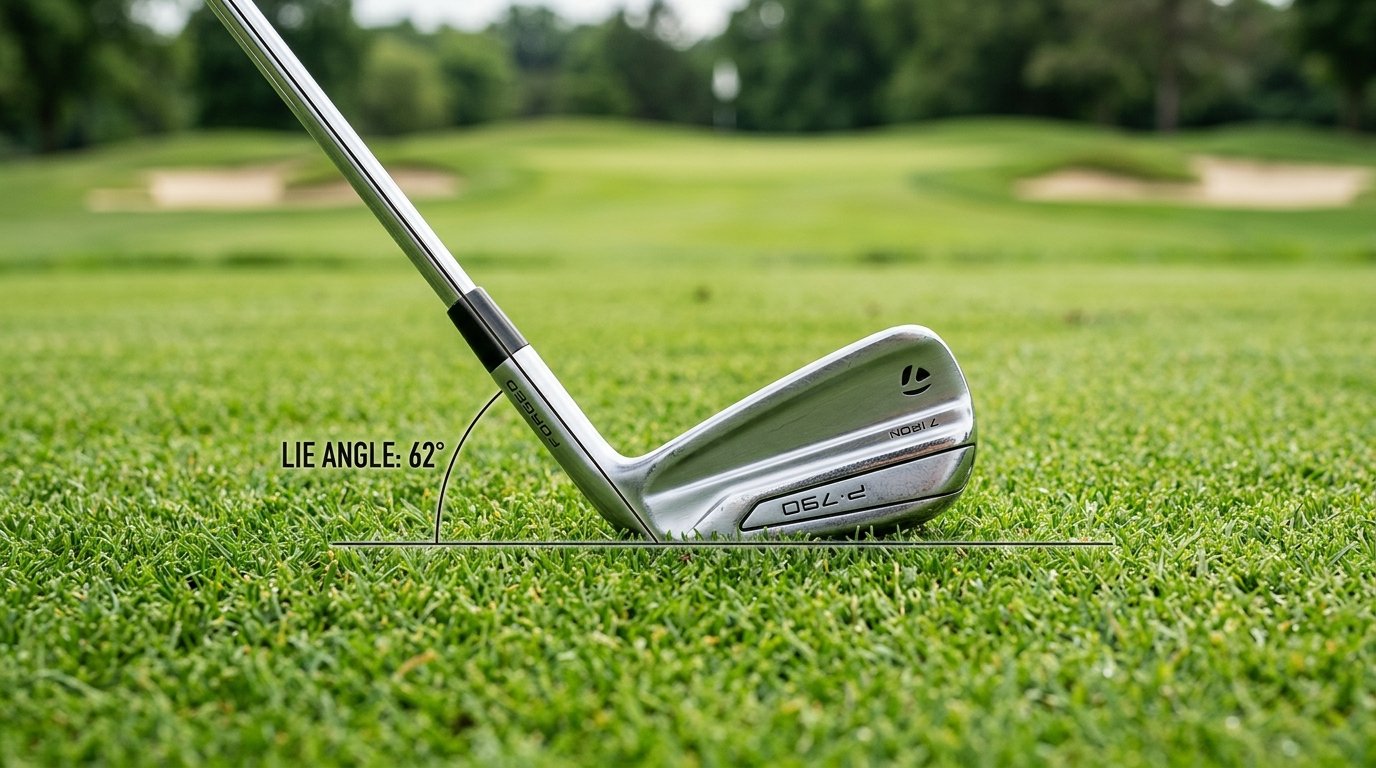
Lie angle is the angle formed between the shaft and the sole of a golf club when the club sits flat on the ground in a normal address position. It’s measured in degrees, and every club in your bag has its own number. A driver usually sits close to 56 degrees, a 7-iron runs around 62 degrees, and a putter can reach near 70 degrees.
That single number quietly decides where your clubface points at the moment you strike the ball. Get it wrong for your height and swing, and shots that feel pure can still start left or right of where you aimed. Here’s what lie angle actually controls, how to check yours, and what to do if it needs adjusting.
How lie angle is measured?
Picture a club resting on the ground with its sole flat and the leading edge square to the target. Lie angle is the angle between the shaft’s centerline and the ground at that point. A small number means the shaft sits closer to flat on the ground; a large number means it stands closer to vertical.
Fitters call this the static lie angle, since it’s measured with the club at rest rather than in motion. Manufacturers set it at the factory using a loft and lie gauge that clamps the head and reads the shaft angle directly. Standard specs vary by brand and even by model. A 7-iron lie angle can run from about 61.5 degrees to 63 degrees depending on the maker, so there’s no single “correct” number across the industry:
| Club (7-iron unless noted) | Typical lie angle |
| Driver | About 56 degrees |
| Mizuno JPX-EZ 7-iron | 61.5 degrees |
| Cobra King F6 7-iron | 62.5 degrees |
| Callaway XR 7-iron | 62.5 degrees |
| PING G25 7-iron | 62.25 degrees |
| Titleist AP1 7-iron | 63 degrees |
| Lob wedge | About 65 degrees |
| Putter | About 70 to 71 degrees |
Lie angle also changes from club to club within a single set. The shorter the shaft, the more upright the lie angle, which is why a pitching wedge sits more vertical than a 5-iron, and why a putter, the shortest club in the bag, has by far the steepest angle of all.
The number that actually matters is different from the one stamped at the factory. It’s called dynamic lie angle, the angle the club forms with the ground the instant it strikes the ball, after your grip, posture, swing plane, and hand position have all done their work. A club can measure perfectly upright sitting still and still play flat, or the other way around, once a real golfer swings it.
How lie angle changes shot direction?
An upright lie angle points the clubface left of the target for a right-handed golfer, because the heel of the club digs into the turf first and rotates the face closed through impact. A flat lie angle does the opposite: the toe hits the ground first, opening the face and sending the ball right. Left-handed golfers see the same pattern in reverse.
Experienced fitters put a rough number on this: for every degree a lie angle is off, the ball tends to fly about four yards off the target line. Two or three degrees out, which is common in clubs bought straight off the rack, can push a shot 8 to 10 yards from where you aimed, even with a clean strike.
The effect is strongest with the shorter, more lofted clubs in your bag, wedges and short irons, because they’re the ones you’re using to aim directly at a flag rather than a fairway. It matters less with a driver, where you can compare setup checks on a page like Titleist’s guide to aim and alignment, but it never disappears completely.
The effect goes beyond just starting direction. A lie angle that’s off at impact tilts the ball’s spin axis slightly to one side instead of leaving it level, which adds a small amount of sideways curve on top of the initial direction the ball starts on. That’s why a bad lie angle often looks like a mild pull or push that gets a bit worse the farther the ball flies, rather than a shot that starts on line and stays there.
A shot that feels solid but consistently lands off to one side is one of the clearest signs of a lie angle problem, not a swing problem.
Signs your lie angle might be wrong
A repeating miss in one direction, paired with contact that feels centered, is the first clue. So is your divot pattern. Take a few swings on a mat or a patch of grass and look at where the divot is deepest. A divot that digs in toward the heel usually means the lie is too upright for you. A divot that’s deeper on the toe side usually means it’s too flat. Uneven wear across the sole of your irons over a season of play tells the same story.
You can get a rough read at home with a dry-erase marker. Draw a straight vertical line down the back of a golf ball, set the ball so the line points straight up, and hit a few shots off a mat. If the line transfers to the clubface tilted toward the toe, your lie is too upright for that swing. Tilted toward the heel means it’s too flat. A line that stays close to vertical suggests the lie angle is close to right.
This test is a starting point, not a verdict, since ground hardness, how deep you catch the turf, and the specific shot you hit can all shift the result. A launch monitor or a lie board, a hard plastic surface with tape on the sole that marks exactly where the club makes contact, gives a far more repeatable answer and is standard at most fitting sessions.
Fitting your clubs to the right lie angle
A proper fitting starts with two measurements: your height and your wrist-to-floor distance, taken with your arms hanging naturally at your sides. Taller golfers, or those with longer arms relative to their height, generally need a more upright lie angle. Shorter golfers, or those with a shorter wrist-to-floor number, generally need a flatter one. Posture matters too. Standing tall at address calls for a more upright lie than standing in a crouched, bent-over setup, independent of height alone.
PING popularized a simple way to apply this with its color code system, still in wide use today. A static color code based on height and wrist-to-floor measurement gives a starting recommendation, and each color corresponds to a lie angle roughly three-quarters of a degree apart from the next, running from about four and a half degrees upright at one end to nearly four degrees flat at the other. The PING color code chart is a useful starting point, though a real swing on a launch monitor or lie board almost always refines that first guess.
Once a fitter has a number, cast and forged steel iron heads can usually be bent one to two degrees flatter or more upright at a clubmaking shop, using a lie and loft machine that applies pressure to the hosel. Many drivers and fairway woods now ship with adjustable hosels that shift lie angle a degree or two without any bending at all.
Fully cast, hollow-body designs and some multi-material heads have less room to bend safely, so a fitter will check what a given model can take before promising a specific adjustment. Dynamic lie angle is also affected by shaft length and grip build-up, since both change how the club sits in your hands at impact, so a fitting session usually checks all three together rather than lie angle alone.
When to get your lie angle checked?
A first fitting makes the most sense any time you buy new irons, since off-the-rack sets ship at one standard spec that fits only a portion of the golfers who buy them. It’s also worth checking after any real swing change, a growth spurt in junior golfers, or an injury that alters your posture or setup.
Many fitters recommend a quick check once a season even without a new purchase, since grips wear down, shafts loosen slightly, and swings drift over months of play. A twenty-minute session with a lie board or launch monitor is enough to confirm whether your current set still matches your swing or needs a small bend.
Hand-me-down clubs and secondhand sets deserve a check before they ever reach your bag. A club built for someone several inches taller or shorter, or with a noticeably different posture, can carry a lie angle several degrees away from what suits you, and no amount of practice will fully cancel that out over a full round.
Conclusion
Lie angle is the angle between a club’s shaft and the ground at address, and the version that matters most is the one your swing actually produces at impact.
Too upright pulls shots left, too flat pushes them right, and either one can cost several yards a shot even when contact feels clean. A quick divot check, a marker test, or a proper fitting session will tell you where you stand, and most iron sets can be bent a degree or two to match.
Frequently asked questions
What is a good lie angle for a 7-iron?
Most 7-irons ship between about 61.5 and 63 degrees, but the right number depends on your height, wrist-to-floor measurement, and posture at address, not a single fixed target.
Does lie angle matter for a driver?
Yes, though less than for irons. Drivers typically sit around 56 degrees, and being off by a degree or two has a smaller effect than it does on shorter, more lofted clubs.
Can I adjust the lie angle myself at home?
Bending a hosel needs a lie and loft machine and practice, so it’s best left to a clubfitter or clubmaker. Adjustable-hosel drivers and fairway woods are the exception, since those settings can be changed by hand.
How much does it cost to adjust lie angle on irons?
Many golf shops and fitting centers bend a set of irons for a modest per-club fee, often somewhere between five and fifteen dollars a club, though pricing varies by location and brand.
How often should lie angle be checked?
Check it whenever you buy new irons, after a significant swing change, or about once a season, since normal wear and small swing changes can shift what fits you best.
Related Articles
How to Wash Golf Clubs: A Complete Step-by-Step Guide
What to Wear to a Golf Tournament as a Spectator?
What Is the Most Expensive Golf Ball?
How to Wash Golf Gloves Without Wrecking Them?